You know every label on the biology diagram. But ask yourself how the parts actually work together, and suddenly you are back at the start. Math does the same thing: every line of the worked solution makes sense, and the next problem stops you in exactly the same place. What is missing is rarely a definition. It is the one step nobody slowed down to show you.
Ahaboard, the AI whiteboard tutor from the team behind ThetaWave, is built for that step. It writes out the reasoning on a whiteboard while it explains, and stops when you want to try the next part yourself. You can speak or type, so it works in a silent library too.
Every example below comes from a real Ahaboard lesson, and you can repeat any of them with the free lesson time.
Start with the part you are stuck on
You do not need the perfect question. “Why does this happen?” is enough, as long as you can name the idea or show the step you tried. Ahaboard starts with three choices: Topic for a concept, Homework for a problem in front of you, and Exam Prep for practice with your own material.
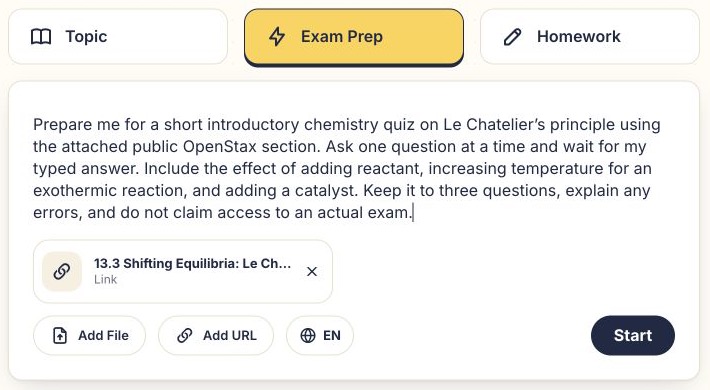
What matters is saying where you got stuck. “I know the formula for slope, but I do not understand why we divide by the change in x” tells the tutor exactly where to begin. So does “I can name the stages of photosynthesis, but I cannot connect them.” Either way, you skip the definition you already know.
A monarch chrysalis: one photo, the whole life cycle
Look at the chrysalis below. The gold spots catch your eye first, but the real question is what is happening inside — how does a leaf-eating caterpillar pass through this still, quiet stage and come out a butterfly?


Put the photo on the board and ask what is going on inside. The answer starts with the pupa — the stage between caterpillar and adult. The caterpillar eats and grows; the pupa does not eat at all while the adult body takes shape. From that one photo, the whole life cycle falls into place:
| Stage | What is happening | What it eats |
|---|---|---|
| Egg | A new individual develops | Nothing yet; the embryo lives on the egg’s reserves |
| Caterpillar (larva) | It eats and grows fast | Milkweed, and only milkweed |
| Chrysalis (pupa) | The adult body takes shape | Nothing |
| Adult butterfly | The winged adult emerges | Nectar from flowers |
You can also ask for the whole cycle at once. When asked for one labeled diagram that stays on the board, Ahaboard drew this:
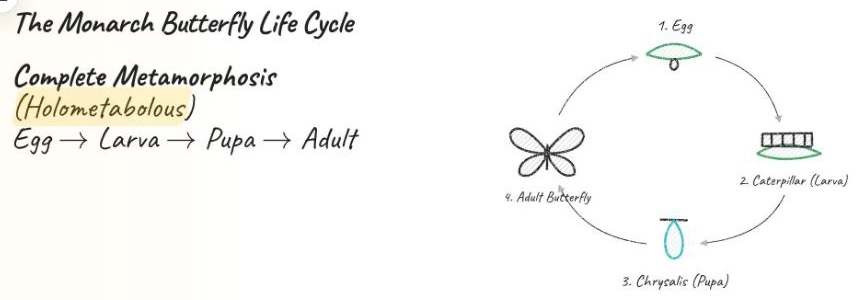
Now push on it: ”If the adult drinks nectar, why does the monarch need milkweed at all?” That question ties two rows of the table together — caterpillars eat only milkweed, while adults drink nectar from many kinds of flowers. The U.S. Fish and Wildlife Service’s monarch assessment covers this dependence. Being able to explain it to someone else is worth far more than four memorized labels.
That is the best way to use the board: stay with one picture and keep asking about the link you cannot explain yet. “What happens next?” usually teaches you more than “What is this called?”
Photosynthesis: follow what moves between the stages
Photosynthesis has enough vocabulary to fill a page of notes, and most of it does not stick. It gets much easier once you stop listing names and start tracing what passes from one stage to the next. Start with a question that catches a common mix-up: does the oxygen a plant releases come from water, or from carbon dioxide?
It comes from water. Once that clicks, the next question follows on its own: what else passes between the stages? That is where ATP and NADPH come in:
| Process | Location | How it links to the other stage |
|---|---|---|
| Light-dependent reactions | Thylakoid membranes | Light energy drives ATP and NADPH production; splitting water releases oxygen |
| Calvin cycle | Stroma | ATP and NADPH power carbon fixation from CO₂; G3P goes on to build sugars |
Check the same path against the OpenStax light-reaction diagram and Calvin-cycle explanation. The goal is not to recite two processes. It is to say what the first one hands to the second.
Try asking like this:
Explain photosynthesis at high-school level. Ask me where the released oxygen comes from, then ask how ATP and NADPH connect the two stages. Wait for my answer before you continue.
The last sentence is the one that matters. Without it, you get a lecture. With it, you have to put the idea into your own words while the explanation is still on the board.
The same approach works for the rest of cell biology. Two questions worth asking:
| Topic | A question worth asking | The idea it opens up |
|---|---|---|
| A photosynthetic leaf cell and an animal cell | Why does a plant cell need mitochondria if it has chloroplasts? | Chloroplasts build sugars; mitochondria make ATP through respiration |
| A nuclear gene in a eukaryotic cell | How does the message reach a ribosome if the gene stays in the nucleus? | mRNA carries the message out of the nucleus; the gene’s DNA stays inside |
Keep a course diagram open while you talk. OpenStax has clear figures for eukaryotic cells, transcription and protein synthesis. Two details to get right: a photosynthetic leaf cell is one kind of plant cell, and not every plant cell has chloroplasts; and the second question is about nuclear DNA specifically. Afterwards, cover the caption and try to explain one arrow in the diagram. The arrow you cannot explain is your next question.
Calculus: why two lines with the same slope are not the same line
A small calculus problem shows what the board is good at. For f(x) = x², take the secant through (1, 1) and (3, 9). Subtract the y-values and you get 8, but that is only the rise, not yet the slope.
Secant slope = (9 − 1) / (3 − 1) = 8 / 2 = 4.
Here is the interesting part. The tangent at x = 2 also has slope 4. Is it the same line? Write both equations side by side and the answer is clear:
- Secant through (1, 1) and (3, 9): y = 4x − 3
- Tangent at (2, 4): y − 4 = 4(x − 2), which is y = 4x − 4
Same slope, different intercept, so the two lines are parallel. One step further: the derivative of x² is 2x, so moving the tangent to x = 3 makes the slope 6.
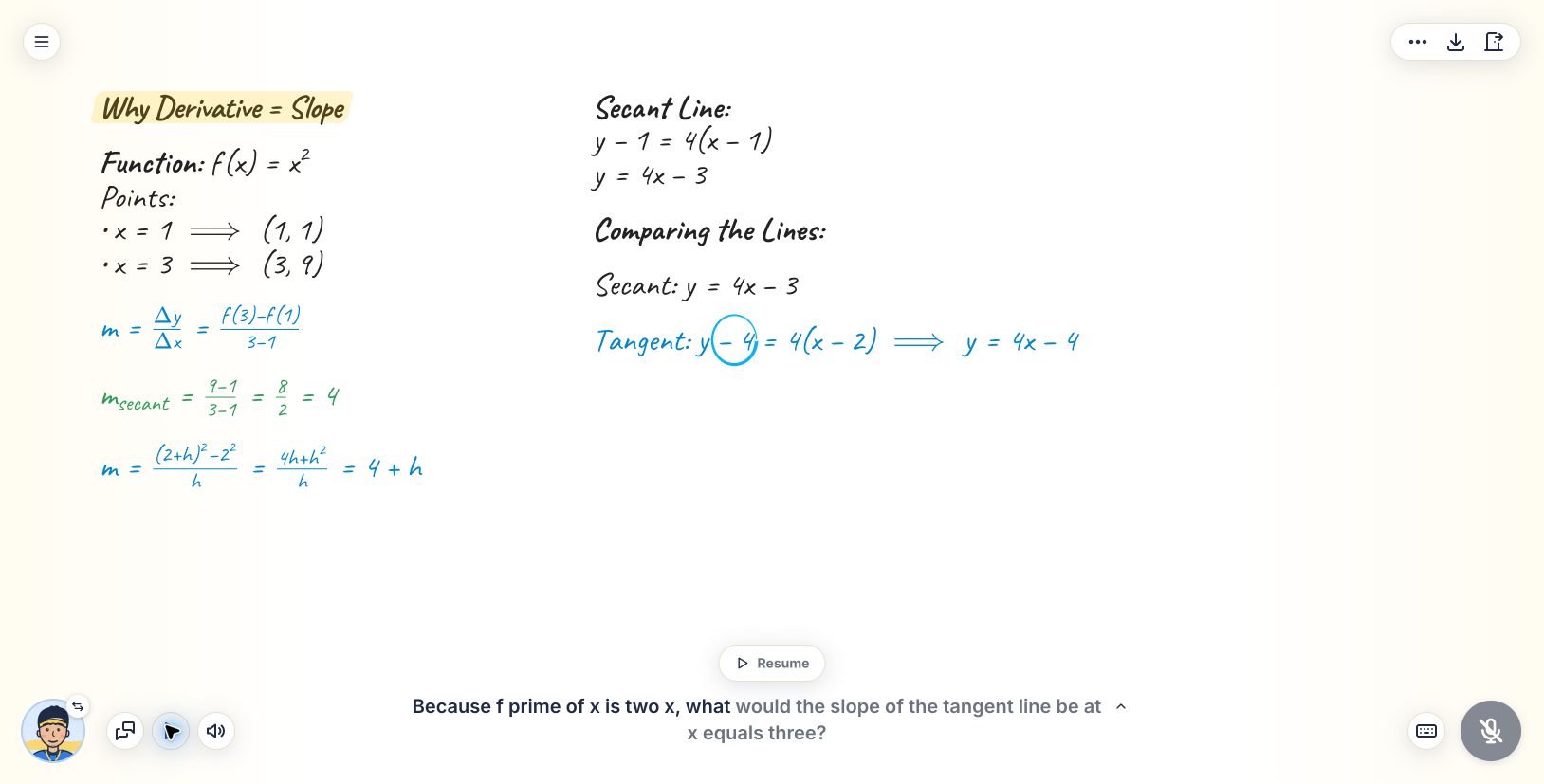
This is the moment to stop and ask, “But if both slopes are 4, why is it not the same line?” On the board you can ask without worrying about holding anyone up, and keep asking until you could explain the difference between slope and intercept to a classmate.
Algebra homework: one hint, not the answer
Sometimes you want a nudge and nothing more. Show the line you are unsure about and say so: one hint, then let me try.
For 3(x − 2) = 2x + 5, a common slip is writing 3x − 2 = 2x + 5. The hint Ahaboard gave here was not a correction but a question: which terms does the 3 outside the bracket actually multiply? That question is enough to get you to 3x − 6, and the rest of the problem is still yours to do.
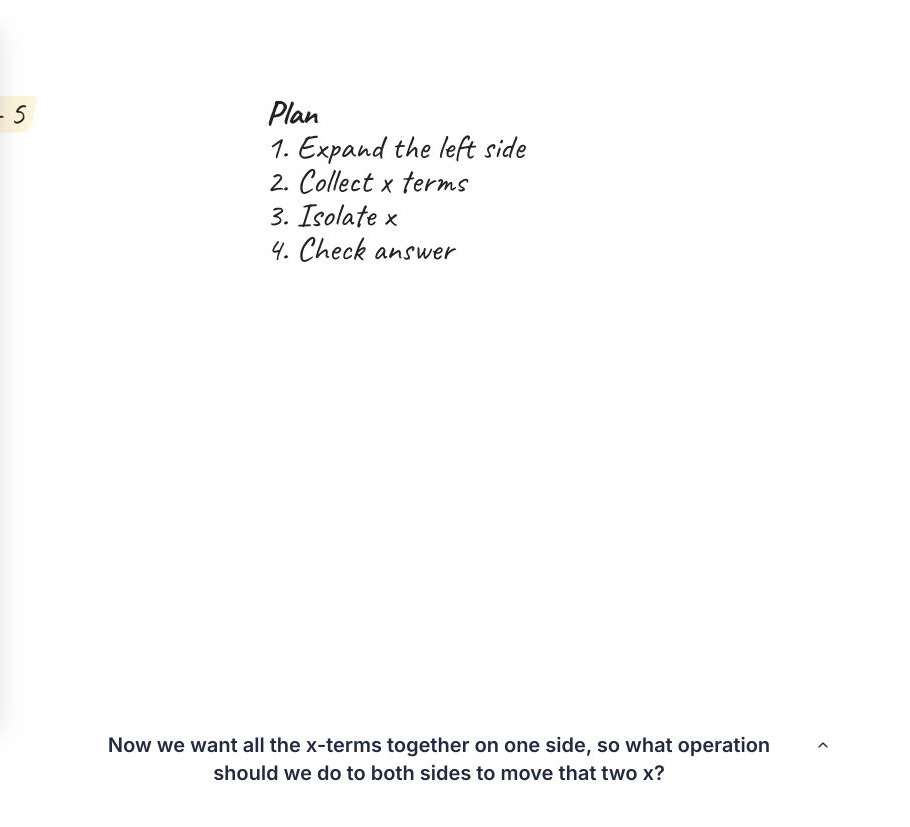
From there, subtract 2x to get x − 6 = 5, then add 6: x = 11. Substitute it back into the original equation and both sides come to 27. You finish with an answer and a way to check it, which is the part homework help usually skips. If the homework is graded, check what your school allows first.
Exam prep: bring your own chapter
When you move from homework to revision, Exam Prep and Add URL let you point the tutor at the material you will actually be tested on. Add URL takes a web page, a public PDF, Word or PowerPoint file, a YouTube video or playlist, or an arXiv paper.
A single OpenStax section on Le Châtelier’s principle is enough to practice two ideas that are easy to mix up: heating an exothermic reaction lowers K, while a catalyst only speeds up the approach to equilibrium and leaves K unchanged at the same temperature.
Bring the chapter you are working on and one question about it. When you are done, close the source and try a similar question without it.
What you keep after the lesson
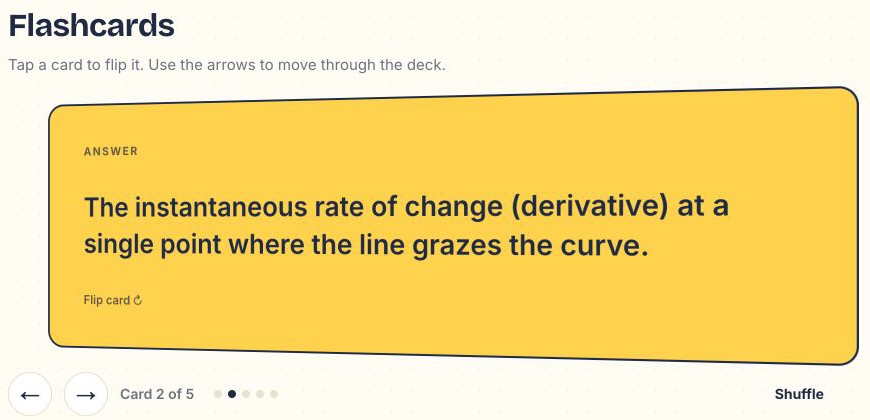
An explanation can feel obvious while it is in front of you and be gone by the next morning. The calculus lesson above ended with a recap, three multiple-choice questions with instant feedback and five flashcards, and that is the part worth coming back to.
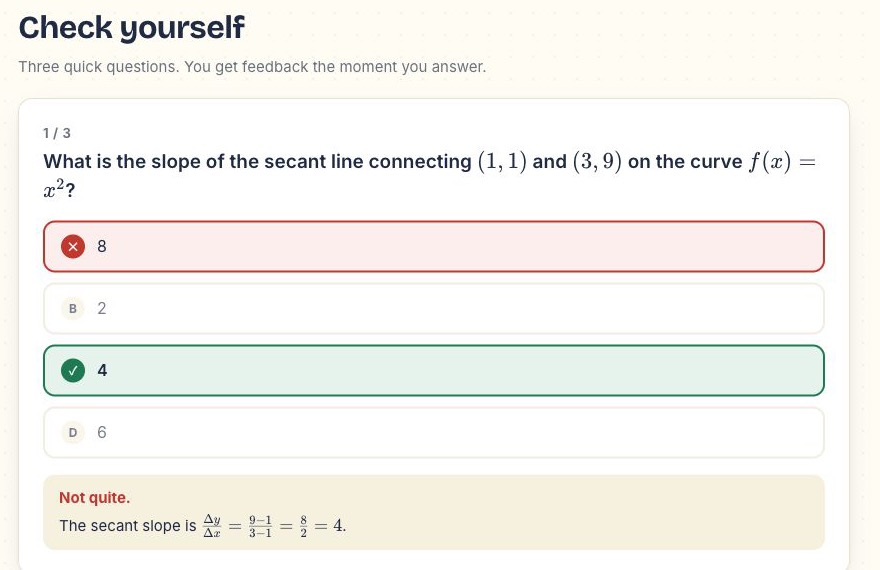
Answer before you flip a card. If you hesitate on one, go back to that idea instead of rereading the whole lesson. If you would rather see how you got there, Replay lesson steps back through the conversation.
Two limits are worth knowing before you rely on it. Diagrams drawn on the board are not always complete, and they can be missing when you reopen a lesson, so keep the textbook figures you depend on somewhere of your own. Credits and key facts are worth checking against the original source.
Keep those diagrams with your own biology notes, and turn the questions you hesitated on into active recall and spaced repetition.
Free lessons and prices
You start with 30 minutes of free lesson time, with no card required. After that, the terms give you two free lessons a day, up to ten minutes each, resetting at 00:00 UTC. That is enough for a first try: pick one question you have been avoiding and work it through to the end.
For more than that, the pricing page listed these USD prices on October 22, 2026:
| Plan | Price | Renews |
|---|---|---|
| Weekly | $14.99 per week | Automatically until you cancel |
| Quarterly | $78 every three months | Automatically until you cancel |
| Annual | $164 per year | Automatically until you cancel |
One more limit: “unlimited” lessons stop at a fair-use ceiling of three active lesson hours per UTC day. Saving the board as a PNG is a paid feature, so on a free account the download button shows an upgrade prompt instead of a file.
Bring the question you keep getting stuck on
You do not need a whole chapter to start. The green chrysalis, the oxygen in photosynthesis, the two lines that share a slope: any one of them is enough. Ask in your own words, answer the follow-up questions, and point to the step that still feels shaky.
Open Ahaboard with that one question. A good first sentence is: “Explain this on the whiteboard, then let me try the next step.”