
Choosing a study method is easier when you stop asking which technique is universally best and start asking what the exam will require you to produce. Remembering a list, explaining a mechanism, solving an unfamiliar problem, and building an evidence-based argument are different jobs. A method can be useful for one and poorly matched to another.
Use the five-question selector below to get a practice plan, then try its example before choosing your own course material. The active recall and spaced repetition guide explains the two foundations used in several plans.
This guide works as a practical study method selector. It helps you identify the assessed action, choose a method that rehearses that action, and test the choice before committing a full week of study time. The goal is a defensible starting point, not a personality label or a perfect schedule.
Find a study method for your next session
Choose the action your exam requires, the material you have, and what failed on your last attempt. Session length changes the time split; the exam date changes when to retry. The result explains what to practice, how to check it, and a small example with an answer you can keep hidden until you have tried.
Your next study session
Answer five questions for a small practice plan. No account needed. This is a starting suggestion, not a learning-style test or a grade prediction.
The selector uses the practical rules explained in this article. Its combinations have not been tested as a personalized assessment. A ten-minute trial can reveal a missing step; it cannot establish long-term learning or predict a grade. If you prefer to choose manually, use the decision table below.
Key takeaways
- Choose a study method by the action you must perform, not by a claimed learning style.
- Use retrieval and spacing for durable access to knowledge, then add diagrams, problems, cases, or arguments when the exam demands them.
- Study material and exam format both matter. A vocabulary-heavy course needs a different mix from a calculation or essay course.
- Test a method with a small, representative set of material before converting an entire course.
- Keep one outcome measure: what you can answer, explain, draw, solve, or write with the source closed.
- A study method generator can propose a starting workflow, but it cannot verify the course rules, source accuracy, or why you missed a question.
Start with the exam action, not a learning-style label
The phrase “best study method for me” often leads to a quiz that sorts students into visual, auditory, reading, or kinesthetic types. Preferences can affect whether a format feels comfortable. The stronger claim—that students learn better when instruction is matched to a declared learning style—does not have adequate evidence behind it. Pashler and colleagues reached that conclusion in their review of learning-styles evidence.
A safer selector begins with observable demands. What will the course ask you to do without the answer in front of you? The syllabus, learning objectives, grading rubric, sample questions, assignments, instructor guidance, and past feedback provide better signals than a personality result.
Write the action as a verb plus an object:
- Recall anatomy terms and locations.
- Explain how a policy changes incentives.
- Distinguish two similar chemical reactions.
- Solve a new statistics problem and justify the method.
- Evaluate a study's evidence and limitations.
- Write a timed argument using course sources.
If the exam format is still unknown, confirm it with the instructor or teaching assistant. Until then, mark your plan as provisional and use a small mix of recall, explanation, and application. Uncertainty about the assessment is a reason to test several prompt types, not a reason to build an elaborate system around a guess.
A study method selector by learning job
Use the table as a routing tool. Start with the row that most closely matches the assessed action, then adapt it to the course material. Several rows may apply to the same exam. On a small screen, swipe the table sideways to read every column.
| What you must do | Useful starting method | What a real attempt looks like | Common mismatch |
|---|---|---|---|
| Recall terms, facts, formulas, or steps | Retrieval practice plus spaced review | Answer a precise prompt before checking, correct it, and schedule another attempt | Rereading cards or revealing the answer immediately |
| Explain a mechanism or relationship | Self-explanation, a concept map, then retrieval | Reconstruct the causal chain or map with the source closed | Copying a polished explanation while the source stays visible |
| Identify or label a visual structure | Blank-diagram practice | Draw or label the structure, then compare with an accurate source | Looking at the finished diagram and mistaking recognition for recall |
| Solve a procedure or calculation | Worked examples followed by independent problems | Explain each decision in an example, cover it, then solve a changed problem | Repeating one template without learning when it applies |
| Distinguish similar categories or problem types | Comparison prompts and interleaved practice | Mix examples, classify each one, and justify the choice | Mixing material before the basic categories are understood |
| Analyze a case, source, or experiment | Claim-evidence-limit table plus new cases | Identify the claim, evaluate the evidence, state a limit, and apply the principle elsewhere | Memorizing conclusions without practicing judgment |
| Build an essay or long answer | Question-led notes, outline retrieval, and timed writing | Produce a thesis and evidence structure from memory, then write under a realistic limit | Memorizing isolated facts without practicing organization |
| Perform under exam conditions | Past papers or representative practice tests | Attempt a sampled paper with the expected timing, tools, and response format | Treating generated questions as predictions of the real exam |
The rows are starting combinations rather than exclusive techniques. Retrieval practice appears in several forms because “retrieve” can mean saying a fact, drawing a process, solving a problem, or producing an argument plan. The prompt should resemble the performance you need.
A completed trial: stop choosing the wrong calculation
This is an original teaching demonstration by Thetawave Team, September 12, 2026. The answers are deliberately simple so you can see how the study decision works. They are not records of a real student's performance.
Selector inputs: solve a calculation → worked examples → chose the wrong method → 20 minutes → exam within a week. Select Try the worked example above to load that exact combination.
Result: worked examples followed by independent problems, with a comparison step before calculating. Use 4 minutes to prepare, 10 to attempt, and 6 to check and repair. These time allocations are adjustable planning defaults.
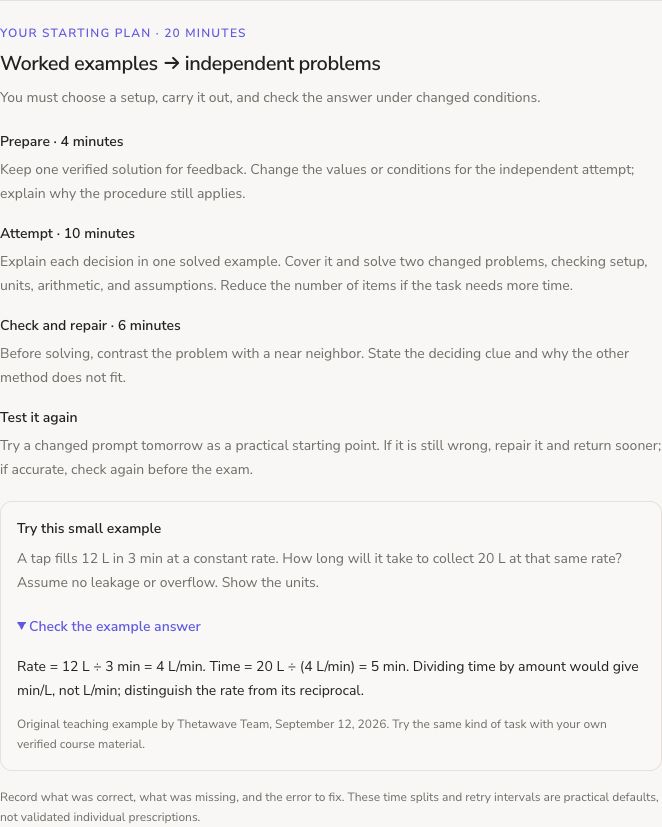
1. Prepare a checked example
A tap fills 12 liters in 3 minutes at a constant rate, without leakage or overflow. Find the time needed to collect 20 liters at the same rate.
- The requested quantity is time. First find the rate: 12 L ÷ 3 min = 4 L/min.
- Use time = amount ÷ rate: 20 L ÷ (4 L/min) = 5 min.
- Check: 4 L/min × 5 min = 20 L. The units and reconstructed amount agree.
A common wrong setup is 3 ÷ 12 = 0.25 and then calling the result a rate in L/min. It is actually 0.25 min/L, the time per liter. That reciprocal is usable only if you keep its meaning: 20 L × 0.25 min/L = 5 min. The repair is to name the quantity and units before selecting an operation.
2. Cover the example and attempt changed questions
Write both answers before opening the solution. Keep the constant-rate, no-loss, no-overflow assumptions.
- A second tap fills 18 L in 6 min. How much does it collect in 4 min?
- The first tap still supplies 4 L/min. How long does it take to collect 14 L?
Check both practice answers
1. Rate = 18 L ÷ 6 min = 3 L/min. Amount = 3 L/min × 4 min = 12 L. This question asks for amount, so multiply rate by time.
2. Time = 14 L ÷ (4 L/min) = 3.5 min, or 3 min 30 s. This question asks for time, so divide amount by rate. Check: 4 × 3.5 = 14 L.
3. Record the error and choose the next attempt
Here is a filled demonstration record, showing how to use an incorrect answer rather than only count correct ones. Swipe the table sideways on a small screen:
| Attempt | Demonstration answer | Check | Next action |
|---|---|---|---|
| Find the rate for 12 L in 3 min | “0.25 L/min” | Wrong units and quantity: 0.25 is min/L | Label amount, time, and requested quantity before calculating |
| Find the amount at 3 L/min for 4 min | “12 L; rate × time” | Correct setup, units, and result | Attempt a time question without the source |
| Find the time for 14 L at 4 L/min | “3.5 min; amount ÷ rate” | Correct setup, units, and result | Retry a changed question tomorrow, then adjust the gap |
For the delayed retry, use 21 L at 3 L/min: find the time. The checked answer is 7 min. Make your attempt before consulting this line. If you again divide in the wrong order, return to quantity-and-unit comparisons; adding more definition cards alone would leave that specific problem unresolved.
For your own course, replace these arithmetic questions with two instructor-aligned problems and keep the same record: setup, conditions, units, result, and error to repair. One successful session is a reason to test again after a delay, not proof that the method will improve an exam score.
What the research supports—and where it stops
A widely cited review by Dunlosky and colleagues evaluated ten learning techniques and rated practice testing and distributed practice as high-utility approaches across many conditions. That supports a general backbone: attempt knowledge from memory, check the attempt, and return after a delay. It does not mean every subject should be reduced to definition flashcards.
The Institute of Education Sciences guide on organizing instruction and study also recommends spacing learning, using quizzing with active retrieval, alternating worked examples with problem solving, and connecting abstract ideas to concrete examples. The recommendations point to a system with several parts. They do not identify one branded technique or fixed timetable that fits every course.
Method boundaries matter. An interleaving meta-analysis found that effects varied with the similarity and type of material. Mixing problem types can help students learn to decide which approach applies, but it is not automatically beneficial for every task. A student may first need a clear example and basic category knowledge before mixed practice becomes diagnostic.
In an experiment on test-enhanced learning, retrieving studied prose improved delayed retention more than repeated study; the immediate retrieval tests in that experiment did not include feedback. For a course workflow, add a separate accuracy check: answer before looking, compare the response with a reliable source, repair the error, and try again later. A confident wrong answer without correction is not a successful study method.
Choose the method in five questions
You can turn the evidence and exam signals into a short decision process.
1. What must I produce with the source closed?
Name the smallest assessable action. “Understand chapter six” is too broad. “Explain why the second stage changes the output,” “choose the correct formula from a new scenario,” or “compare two theories using evidence” gives you something to rehearse and score.
If the course has several actions, estimate their importance from official material. A multiple-choice section can still test application; an essay can still depend on precise factual recall. Use the actual questions and rubric when available instead of inferring difficulty from the response format alone.
2. What material must the method preserve?
The source changes the workflow. A diagram-heavy biology unit needs visual relationships. Mathematics needs conditions, steps, and error checks. A research paper needs claims, methods, evidence, and limitations. Literature and history may need exact source anchors alongside interpretation.
Choose a note or prompt format that preserves what can change the answer. The guide to taking notes from a textbook without copying explains how to select mechanisms, conditions, examples, and source anchors rather than duplicating every paragraph.
3. What failed on the last real attempt?
Use an error as routing evidence:
- If the answer looked familiar but would not come to mind, add retrieval.
- If it was correct today and missing days later, add spacing.
- If you knew facts but could not connect them, add explanation, comparison, or mapping.
- If you knew the method but chose it for the wrong problem, add mixed classification and interleaving.
- If you could solve practice slowly but not under exam conditions, add representative timed work.
- If the answer was fluent but inaccurate, strengthen source checking and feedback before adding more repetitions.
This diagnosis keeps the study plan tied to a problem. The article on why rereading notes can create false confidence shows why familiarity is weak evidence when the exam requires production.
4. What is the smallest useful trial?
Do not convert an entire course into flashcards, maps, or summaries before testing the method. Select one representative topic and create five to ten prompts, two problems, one diagram, or one essay outline. Attempt the set with the source closed, check every response, and record the kind of error.
A useful trial should be difficult enough to expose a gap but small enough to revise. If the method creates hours of preparation and only minutes of relevant practice, simplify it. If it is fast but omits the relationships or decisions the course grades, add a richer prompt.
5. When will I test it again?
Immediate success may reflect short-term access. Schedule another attempt after a delay, then adjust based on performance and the exam date. The guide to active recall and spaced repetition explains the difference: recall is the action, while spacing determines when that action returns.
Avoid false precision. There is no universal sequence of intervals that fits every student, topic, and deadline. Return sooner to wrong or incomplete material, later to material that was accurate and easy, and keep a small sample of older items in the review queue.
Match the method to the kind of exam
Fact-heavy exams
Start with accurate, bounded prompts for terms, structures, formulas, or sequences. Add an example or contrast when a fact can be confused with a close alternative. A flashcard maker for verified course material can reduce setup work, but the card becomes retrieval practice only when you answer before revealing it.
Do not let a large deck hide the exam's deeper questions. If the test also asks for mechanisms or cases, move some facts into why, how, compare, and apply prompts.
Problem-solving exams
Begin with worked examples when the procedure is new. Explain why each step is taken and when the method applies. Then cover the example and solve a changed problem. Once individual types are stable, mix them so you must classify the problem before calculating.
A correct final number can hide a fragile method. Check the setup, assumptions, units, intermediate decisions, and explanation. Practice should reveal whether the failure came from a missing fact, a classification error, an execution mistake, or time pressure.
Essay and evidence-based exams
Turn the prompt into a claim-evidence-limit structure. Retrieve a thesis, relevant course evidence, a counterargument or limitation, and the connection between them before writing the full response. Keep source details accurate and separate quoted language from your own interpretation.
Timed writing should come after you can build a coherent outline. Speeding up an unsupported argument does not solve the evidence problem.
Mixed-format exams
Map each section to its required action, then allocate methods accordingly. One course may need terminology cards, blank diagrams, case classification, and a timed short answer. A single method is convenient, but convenience is not the same as coverage.
Use a representative practice set to find which action is weakest. A quiz maker for mixed question types can create a draft from permitted, verified notes. Check every item against the source, remove ambiguous questions, and do not assume a generated quiz predicts the instructor's exam.
Can a study method generator choose for you?
A study method selector or generator can help organize the first decision. It can ask about the exam action, material type, deadline, and last error, then suggest a small trial. That is useful when the alternative is an unstructured list of techniques.
The generator cannot confirm the assessment format, judge whether a source is accurate, observe a hidden misconception, or guarantee that a technique will improve grades. Treat its result as a hypothesis. The result earns a place in your plan only when a representative attempt produces better evidence: more accurate recall, clearer explanation, correct classification, stronger solutions, or a better-supported response.
Be especially cautious when a selector assigns a method from a personality label. Ask whether the recommendation changes with the exam task. If it gives the same answer for vocabulary, calculus, lab diagrams, and essays, it is probably too broad to guide real practice.
Build a seven-day study method trial
Use this lightweight experiment before adopting a system for the semester:
- Choose one representative topic and write the exact exam action.
- Take a short baseline attempt with the source closed.
- Select one method combination from the decision table.
- Create the minimum useful materials and verify them against the course source.
- Attempt them once, record errors, and repair the weakest link.
- Return after a delay with changed wording, values, examples, or cases where appropriate.
- Compare the delayed attempt with the baseline and decide whether to keep, change, or drop the method.
The comparison does not need a complicated score. Track accuracy, completeness, explanation quality, time, and the type of error. Also track setup cost. A method that improves one small result but consumes the time needed for the rest of the course may need a simpler version.
How ThetaWave fits after you choose the method
ThetaWave can help turn permitted lectures, PDFs, videos, and text into a shared source note, then create different practice objects from that checked material. The chosen learning job should determine the output: compact prompts for exact recall, quizzes for mixed questions and application, or a mind map for relationships and mechanisms.
Keep the decision loop outside the automation. Verify generated material against the source, answer before looking, inspect why an attempt failed, and change the prompt or method when the evidence changes. ThetaWave can reduce conversion and formatting work; it cannot decide what the instructor will assess or make an unchecked answer reliable.
Decide what to keep after the trial
The best study method is the one that rehearses the performance your course requires and survives a delayed, closed-source test. Start with the exam action, preserve the right features of the material, choose a small method combination, and use errors as routing evidence.
Run the seven-day trial before rebuilding your entire study system. Keep the method when it improves the relevant performance at a reasonable setup cost. Change it when the practice feels productive but does not improve what you can recall, explain, draw, solve, classify, or write.