
Physics notes have to preserve more than facts. A useful page should show which principle applies, what the diagram means, why an equation is valid, where a derivation changes direction, and how a worked problem was checked. If your notes keep only formulas and final answers, they may look compact while leaving you unable to start a new problem.
The Physics Notes study page can help you organize material from lectures, textbook chapters, slides, and PDFs. This guide covers the method around that material: how to take physics notes before, during, and after class so they become a tool for reasoning. The approach works for mechanics, electricity and magnetism, waves, thermodynamics, and other courses where concepts, diagrams, mathematics, and problem solving have to stay connected.
For a related example of keeping conditions beside an equation, the filled two-column chemistry note shows how one changed assumption changes the answer, with a reusable print worksheet.
Key takeaways
- Build each physics note around a principle, representation, equation, assumptions, worked example, and check.
- Record why each derivation step is allowed instead of copying a chain of symbols without its reasoning.
- Keep a problem log that captures the model choice and the error, not only the correct final calculation.
- Use flashcards for compact relationships and units; use fresh problems and short-answer prompts for application.
- Let AI organize a first draft, then verify symbols, signs, units, diagrams, assumptions, and instructor-specific conventions against the source.
Why physics notes need a problem-solving structure
Physics courses ask you to move among words, diagrams, graphs, equations, and physical situations. Those are different representations of the same model, and a useful note makes the connection visible. Writing F = ma is much less valuable than recording the system, forces, chosen axes, assumptions, and reason that Newton's second law applies. When those decisions disappear, the note becomes a formula list that works only for problems you already recognize.
The University of Rochester's study tips for introductory physics students recommends reading before lecture, following the algebra with pencil and paper, and reviewing both the most important and the most confusing parts of a lecture. That advice points to the real job of college physics notes: prepare enough context to follow the argument, then preserve the decisions you will need to reproduce later.
Physics also punishes small missing conditions. An equation may assume constant acceleration, negligible air resistance, a closed system, a small angle, or a particular sign convention. The equation can be copied correctly and still be used incorrectly. Your note structure should therefore give assumptions and limits a fixed place rather than leaving them in the margin or in memory.
Use a six-part physics note block
For each major concept, create the same six-part block. The format is flexible enough for a notebook, tablet, or digital document, but consistent enough that you can see what is missing.
On a small screen, scroll the table sideways.
| Note block | What to record | Example for an inclined plane |
|---|---|---|
| Principle | The physical idea in plain language | Net force along the slope changes the object's motion. |
| Representation | Diagram, graph, or coordinate choice | Free-body diagram with axes parallel and perpendicular to the plane. |
| Equation | The relationship plus variable meanings and units | Sum of forces parallel to the slope equals ma. |
| Assumptions | Conditions that make the model usable | Rigid object, constant mass, stated friction model, negligible air resistance. |
| Worked example | One setup that shows how the model is chosen | Resolve weight into components before substituting numbers. |
| Check | A test of sign, units, scale, or limiting behavior | Acceleration should have units of m/s² and a direction consistent with the diagram. |
This block keeps the conceptual and mathematical parts on the same page. If you have an equation without a representation, add the diagram or graph that gives the symbols meaning. If you have a worked example without a named principle, write the decision that made the first step possible. The goal is a note that helps you choose a model, not a page that only confirms an answer after you have seen it.
Filled physics note: a block on a slope
Here is the six-part format filled in, including the reasoning a formula list leaves out. This is an original editorial teaching example, created September 19, 2026. It is not a student's submitted work or a product-generated result. The force model is checked against OpenStax's normal-force and inclined-plane discussion.
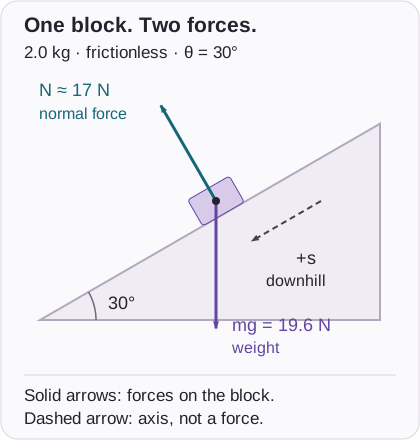
Problem. A 2.0 kg block slides down a fixed, straight slope at 30° to the horizontal. The surface is frictionless, air resistance is negligible, and the block stays in contact with the slope. Use g = 9.8 m/s². Find its acceleration along the slope and the normal force. Treat the block as a particle; no other force is applied.
1. Principle: name the system and the question
The system is the block. Apply Newton's second law to find acceleration from the net force, rather than inserting the full weight into the slope equation. The contact condition also lets us find the normal force.
2. Representation: choose axes before signs
Choose +s down the slope and +n perpendicular away from it. Weight mg points vertically downward. The normal force N points along +n. There is no friction force. Resolve weight into mg sin θ along +s and mg cos θ into the slope. These are components of one force, not two extra forces to add alongside mg.
3. Equations: explain each line
Along the slope:
ΣFs = mas — Newton's second law for the chosen axis.
mg sin θ = mas — only the downhill component contributes.
as = g sin θ — divide both sides by the same nonzero mass.
as = 9.8 × sin 30° = 4.9 m/s² downhill.
Perpendicular to the slope:
an = 0 — contact with a fixed, straight slope.
N − mg cos θ = 0 — balance the perpendicular components.
N = 2.0 × 9.8 × cos 30° = 16.97… N, or 17 N to two significant figures.
The cancellation of mass is a result of this model. Do not copy “mass never matters” into the note: an independently specified applied force would add a force-per-mass term.
4. Assumptions: write the boundary beside the answer
The result uses a frictionless, fixed, straight slope; continued contact; constant mass and g; and negligible air resistance. The angle is measured from the horizontal. If the surface is rough, redraw the forces. If the block leaves the surface, do not retain the perpendicular-contact equation.
5. Check: test units, direction, and a limit
The acceleration has units m/s² because sin θ has no units. Its positive sign means downhill under our axis choice. The normal force is smaller than the weight, 19.6 N. As θ approaches 0° in this same model, a approaches 0 and N approaches mg: the flat-surface limit makes sense. Do not use units alone to choose sine over cosine; either would pass that units check.
6. Retrieval cue: reconstruct the decision
Cover the calculation and answer: Why is N not equal to mg here, and why does only mg sin θ appear in the downhill equation? Redraw the two forces, state both axes, and then rebuild the equations. Compare your reconstruction with the completed note before practicing a variation.
Change one condition: four questions with answers
For the rough-surface case, use the distinction between static and kinetic friction in OpenStax’s friction chapter.
Each question starts again from the original 2.0 kg, 30°, frictionless example unless it explicitly changes a condition. Try the setup before opening its answer.
1. The mass becomes 4.0 kg. What changes?
Show the mass-change answer
The acceleration remains 4.9 m/s² downhill because a = g sin 30°. The normal force doubles: N = 4.0 × 9.8 × cos 30° = 33.95… N, or 34 N. Both the downhill gravitational force and the mass doubled; their ratio is unchanged.
2. A rope now pulls the original block uphill with a constant 3.0 N force, parallel to the slope. What is its acceleration?
Show the applied-force answer
Add the rope force uphill. With +s downhill, ma = mg sin 30° − 3.0 N = 9.8 N − 3.0 N = 6.8 N. Divide by 2.0 kg: a = 3.4 m/s² downhill. The normal force remains 17 N because this added force has no perpendicular component. The rope force is specified; this is not an inferred friction force.
3. You choose uphill as positive. Does the motion change?
Show the sign-convention answer
No. In the original frictionless case, −mg sin 30° = ma, so a = −4.9 m/s². The negative sign now means downhill. Changing coordinates changes the signed component, not the physical direction.
4. The block is instead initially at rest on a rough slope. Can you assume it accelerates at 4.9 m/s²?
Show the rough-surface answer
No. Static friction can act uphill. To remain at rest it would need to supply mg sin 30° = 9.8 N, while N is about 17 N. Whether it can do so depends on the maximum available static friction: μsN ≥ 9.8 N, or μs ≥ tan 30° ≈ 0.577. Without that information, you cannot decide whether it starts sliding. If it slides, the kinetic-friction model is also needed to calculate acceleration. Write “missing friction information” instead of carrying over the frictionless answer.
Download and reuse the physics note template
Download the editable physics note and template (TXT). It contains the filled slope note, the four questions with a separate answer section, and a blank six-part note plus error log. Open it in a text editor, save your own copy, and replace the blank fields for one permitted course problem. Draw the diagram on paper or in your usual drawing app; the TXT is plain text, not a formatted or fillable PDF.
Use this completed fictional error-log entry as a model:
- Attempt: “a = g cos 30° = 8.5 m/s² downhill.”
- Diagnosis: Used the perpendicular weight component along the slope. The units were correct, so they did not expose the error.
- Repair: Mark θ from the horizontal, resolve mg on the chosen axes, and label the downhill component mg sin θ.
- Retest: Let θ approach 0°. The repaired expression gives 0; g cos θ incorrectly gives g. Then solve the rope-force question above without opening its answer.
For your next topic, keep the same fields: principle → representation → equation and reasons → assumptions → worked answer and checks → retrieval cue. Add the source chapter or lecture timestamp. The format should preserve how you started and why the answer is valid, so you can reuse it for circuits, waves, or energy without copying the slope's equations.
Before class: build a small lecture scaffold
Previewing physics material does not mean mastering the chapter before class. Spend the preview identifying the section question, the new quantities, the main diagram, and any equation you expect the lecture to develop. Leave space beneath those items so the lecture can fill in the reasoning instead of forcing you to rewrite the slide sequence.
A useful scaffold contains four prompts:
- What physical situation is this section trying to explain?
- Which quantities are known, measured, or changing?
- Which principle might connect those quantities?
- What part of the reading or previous lesson is still unclear?
This preparation changes what you listen for. Instead of treating every board line as equally important, you can notice when the instructor states an assumption, chooses a coordinate system, introduces a definition, or explains why one model is a better fit than another. Keep your unanswered question visible; the moment it is resolved often deserves a clearer note than the surrounding transcription.
During class: capture decisions, not every line
In a fast lecture, copying everything can compete with following the physics. Prioritize the points where the reasoning changes: the system boundary, diagram, sign convention, governing principle, assumption, algebraic move, and interpretation of the result. Slides and textbook definitions can often be revisited. The instructor's explanation of why a step works or why a tempting method fails may be harder to reconstruct.
Use short tags in the margin to reduce writing load:
- P for the physical principle being used.
- A for an assumption or approximation.
- D for a definition or diagram decision.
- Q for a question or unresolved jump.
- E for a worked example worth rebuilding later.
- C for a result check, such as units, direction, or limiting behavior.
The tags should direct your review, not decorate the page. A cluster of Q marks identifies what to bring to office hours or a study group. An A without a stated limit tells you the model needs clarification. An E without P tells you that you copied the calculation without recording how the method was selected.
Record derivations one reason per step
A derivation is useful only if you can later explain the transition between lines. Leave enough vertical space to write a short reason beside each important step: definition, conservation law, substitution, algebra, approximation, boundary condition, or symmetry. You do not need to annotate routine arithmetic, but you should label the move that changes the physical meaning.
MIT OpenCourseWare's discussion of common sources of confusion in physics problem solving notes that a professor may move between derivation lines by introducing a definition rather than performing an algebraic manipulation. That is exactly the kind of transition a copied equation chain hides. Marking the reason keeps the derivation from becoming an unexplained jump when you review it later.
For a longer derivation, finish with three sentences in your own words:
- We started from ___ because ___.
- The key assumption or substitution was ___.
- The result tells us ___, and it would stop being valid when ___.
These sentences turn symbol tracking into a physical explanation. They also reveal whether the difficult part is mathematics, a definition, or the model itself, so you can ask a more precise question.
Turn worked examples into reusable problem templates
Do not treat a worked example as an answer key to copy. Cover the solution and identify the system, known quantities, unknown quantity, diagram, governing principle, and planned check before reading the first line. Then compare your setup with the example. A mismatch in model choice is more important than a small arithmetic error because it will follow you into many different problems.
OpenStax's problem-solving strategy for Newton's laws begins by identifying the physical principles and system of interest, then uses a free-body diagram before translating the situation into equations. The same sequence works beyond mechanics. In circuits you define nodes and loops; in energy problems you define the system and transfers; in waves you identify the model, variables, and boundary conditions.
For every representative example, add a compact problem template:
On a small screen, scroll the table sideways.
| Problem layer | Question to answer |
|---|---|
| Situation | What is happening physically, and what is the system? |
| Representation | Which diagram, graph, or coordinate system makes the relationships visible? |
| Model | Which principle applies, and what evidence supports that choice? |
| Setup | Which symbolic equation connects the knowns to the unknown? |
| Solve | What algebra or calculation follows after the setup is sound? |
| Check | Are the units, sign, direction, scale, and limiting behavior reasonable? |
Keep numbers out of the setup until the symbolic relationship is clear when the course allows it. This makes the structure easier to reuse and exposes cancellations or dependencies before calculator work begins. After reviewing the example, change one condition and predict what part of the setup would change. That small variation tests whether you understood the model rather than memorized the page.
Keep an error log beside the notes
Physics mistakes are more useful when they are classified. A page of corrected calculations shows what the answer should have been, but it may not show why you went wrong. Add a short error log that points back to the relevant note block.
On a small screen, scroll the table sideways.
| Error type | Example | Repair action |
|---|---|---|
| Model choice | Used constant-acceleration equations when acceleration changes | Write the condition for the model and solve one contrast problem. |
| Representation | Omitted a force or chose confusing axes | Redraw the diagram before writing equations. |
| Sign or vector | Mixed magnitude with a signed component | State the axis direction and label components explicitly. |
| Units or scale | Combined centimeters with meters | Convert before substitution and estimate the expected order of magnitude. |
| Algebra | Lost a factor while rearranging | Redo the symbolic step separately from the physics setup. |
| Interpretation | Accepted an impossible direction or value | Add a physical reasonableness check to the template. |
This layer prevents a common waste of time: repeating whole problem sets when one narrow decision keeps failing. If the same model error returns, revise the original concept note. If the setup is consistently correct but arithmetic is not, keep physics review and algebra practice separate.
After class: compress the lecture into questions
Soon after class, review the P, A, D, Q, E, and C tags while the context is still available. Fill any missing variable definitions, complete diagrams, and write a two- or three-sentence summary of the lecture's central model. Then turn each major note block into one cue question you can answer without looking.
The Cornell note-taking system uses questions, recitation, reflection, and review to move beyond recording. For physics, make the cues model-based: "Why is momentum conserved here?", "What changes if friction is added?", or "Which graph feature represents acceleration?" These questions are more useful than headings such as "Chapter 6" because they tell you what reasoning to retrieve.
Do not rewrite the entire lecture neatly. Repair missing relationships, then test the repaired note. A short closed-note explanation, a redrawn diagram, or the setup for one fresh problem tells you more than another pass of copying.
Turn physics notes into active review
Different parts of a physics note need different study objects. Use flashcards for variable meanings, units, sign conventions, compact laws, and the conditions under which a relationship applies. Use quiz prompts or fresh problems for model selection, diagrams, derivations, calculations, and interpretation. A card should not try to hold an entire multi-step solution.
If your raw material is spread across lecture audio, slides, and a chapter PDF, an AI Notes Generator can create a first structure before you add the six physics-specific blocks. For material already stored in a permitted PDF, the workflow for making flashcards from a PDF shows how to keep card creation connected to the source. Use a Quiz Maker to draft conceptual and calculation prompts, then adjust them to match the notation, problem style, and allowed methods in your course.
The key boundary is verification. Check symbols, equations, diagrams, signs, units, assumptions, and numerical results against the lecture, textbook, or instructor solution before studying from generated material. In physics, a small transcription or formatting error can change the model rather than merely change the wording.
Paper, tablet, or AI-generated notes?
The best medium is the one that lets you draw, annotate, search, and revise without breaking your attention during the reasoning. Paper is fast for diagrams and spatial layouts. A tablet can keep handwriting while making it easier to move blocks and attach slides. Typed notes are searchable and easy to reorganize, but equation entry can slow down a live lecture.
You can also use a hybrid system: rough diagrams and equations during class, followed by a digital concept block and problem log after class. The choice matters less than whether the final note preserves the six parts and leads to closed-note practice. Switching apps will not repair a note that lacks assumptions, model choices, and result checks.
A complete workflow for one physics topic
Use the following sequence for one lecture or textbook section:
- Preview the physical question, new variables, main diagram, and one unresolved point.
- During class, capture the principle, representation, assumptions, and reasoning transitions.
- Annotate derivations with the reason for each meaningful step.
- Rebuild one representative example as a problem template before reading its solution.
- Add a units, sign, direction, scale, or limiting-case check.
- Convert the note into cue questions, compact flashcards, and one or two fresh problems.
- Record misses in the error log and revise the smallest note block that caused them.
This is a narrower workflow than a full semester system. If you need to connect lecture capture, readings, notes, flashcards, quizzes, and exam preparation across several courses, building an AI study system from your notes provides the broader structure. Keep the physics layer specific: every study object should still point back to a model, representation, or problem-solving decision.
Common mistakes when taking physics notes
Copying every equation without its conditions
Write when the equation applies, what each symbol means, and which assumptions or coordinate choices are active. A formula without those boundaries is easy to misuse on a problem that looks similar.
Skipping diagrams because the algebra looks familiar
The diagram defines the system and relationships that the algebra represents. Draw the free-body diagram, circuit, ray path, graph, or control volume before committing to equations when the topic calls for it.
Substituting numbers too early
Keeping the setup symbolic makes the model easier to inspect and reuse. Substitute after the relationship is clear, then use units and scale to check the result.
Recopying solutions instead of logging errors
A clean corrected solution can hide the original failure. Label whether the miss came from model choice, representation, sign, units, algebra, or interpretation, then practice that specific decision again.
Trusting generated notes without checking the source
AI can help organize lectures, slides, and PDFs, but it can misread notation or omit a condition. Verify the physics before turning the output into flashcards, quizzes, or a study guide.
How ThetaWave fits the physics notes workflow
ThetaWave fits when your source material needs to become a clearer first note and then move into review. Start with the physics study page or Notes Generator to organize a lecture, chapter, slide deck, or PDF. Add the six-part physics blocks, keep the original source available for verification, and use flashcards or quizzes only after the concepts, equations, assumptions, and diagrams are sound.
The product should reduce repetitive conversion work, not choose the physical model for you. Your most valuable actions are still defining the system, drawing the representation, explaining the derivation, solving a fresh problem, and checking whether the result makes sense. Use the generated structure to spend more time on those decisions.
The bottom line
To take physics notes that help you solve problems, connect every principle to a representation, equation, assumption, worked example, and check. Mark the reasons inside derivations, rebuild examples as reusable templates, and keep an error log that identifies the failed decision. Then turn the notes into cue questions and fresh problems so the page becomes a tool for reasoning instead of a record of what the instructor wrote.