Structured Notes for Sam Altman on GPT-4 & the Future of AI
The 2.5-hour conversation rewritten as a scannable outline — capabilities, RLHF, deployment philosophy, AGI, and safety — without the transcript clutter.
- Why Altman calls GPT-4 impressive but flawed — and what that means for trust
- RLHF vs raw scale: what actually made the models useful
- Iterative deployment, AGI, and the concentration-of-power risk
Key takeaways
- GPT-4 is powerful but still flawed — Altman stresses humility: it hallucinates, so it's a tool to reason with, not an oracle to trust blindly.
- RLHF (reinforcement learning from human feedback), not raw scale alone, is what made the models genuinely useful and better aligned with human intent.
- OpenAI's core philosophy is iterative deployment: release systems gradually so society and institutions can co-adapt — rather than building in secret and releasing once.
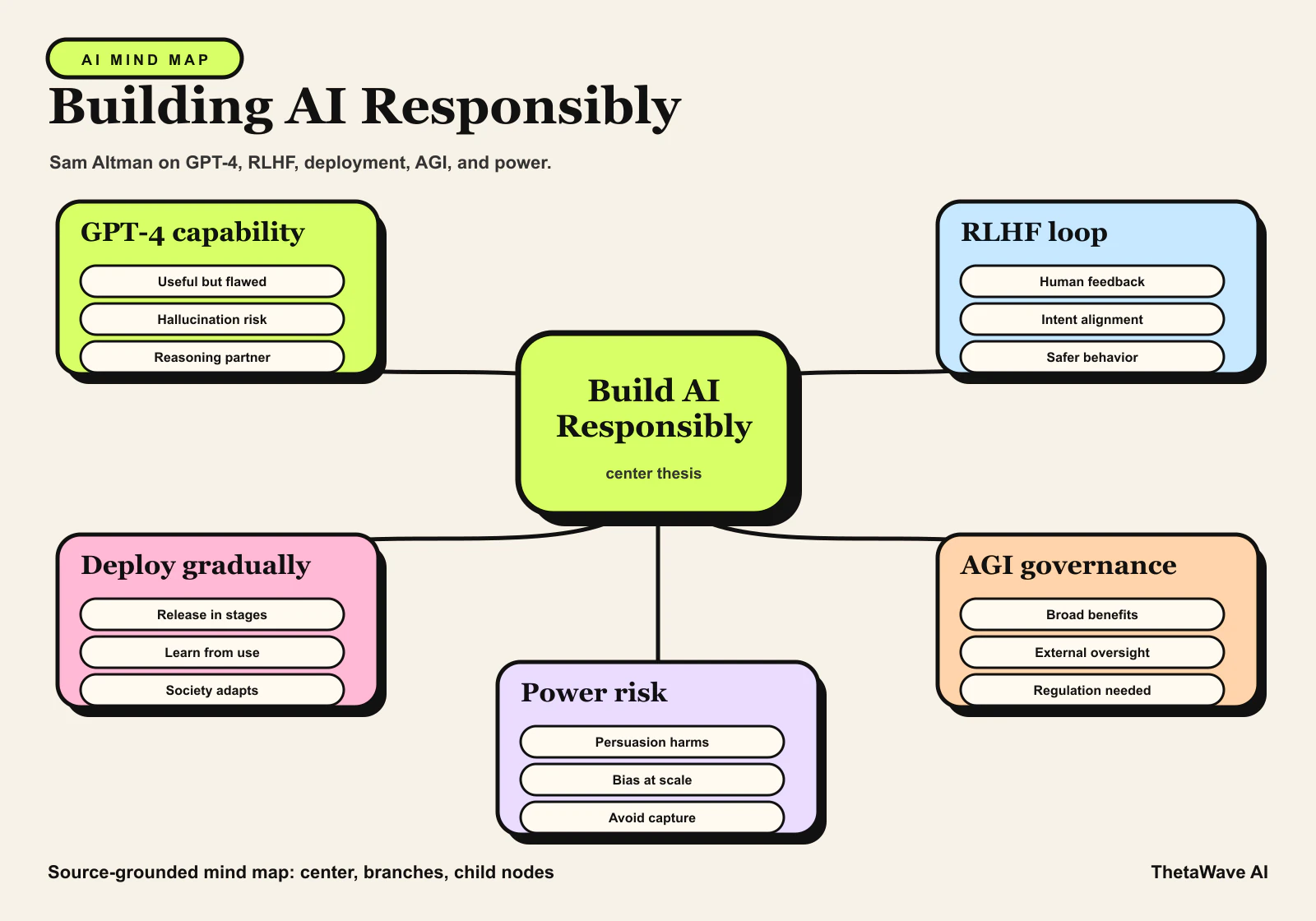
Mind Map — see the whole conversation at a glance
Branches from one center (Building AGI responsibly): GPT-4 capabilities, RLHF & alignment, iterative deployment, AGI timelines, and power & governance.
- Nodes follow the actual conversation flow, grounded in the original talk
- Color-coded by theme: capability, safety, deployment, governance
- Useful as a one-page review for a study group or reading club
Quiz — test your grasp of Altman's claims about AI
Active recall on the conversation's most counter-intuitive points — capabilities, alignment, and what Altman actually worries about.
- True/False on common misreadings of GPT-4 and AGI
- Fixes that explain Altman's actual reasoning
- Short-answer checks so the ideas stick
“Treating GPT-4's confident answers as reliable facts” — is this a recommended approach?
Flashcards — spaced repetition for the key AI concepts
One card per core idea: RLHF, iterative deployment, alignment, AGI, concentration of power. Built to remember the framework, not just the headline.
- Each card pairs a concept with the concrete 'how' from the talk
- Flip to reveal the mechanism plus a practical example
- Repeatable self-testing so the concepts stick
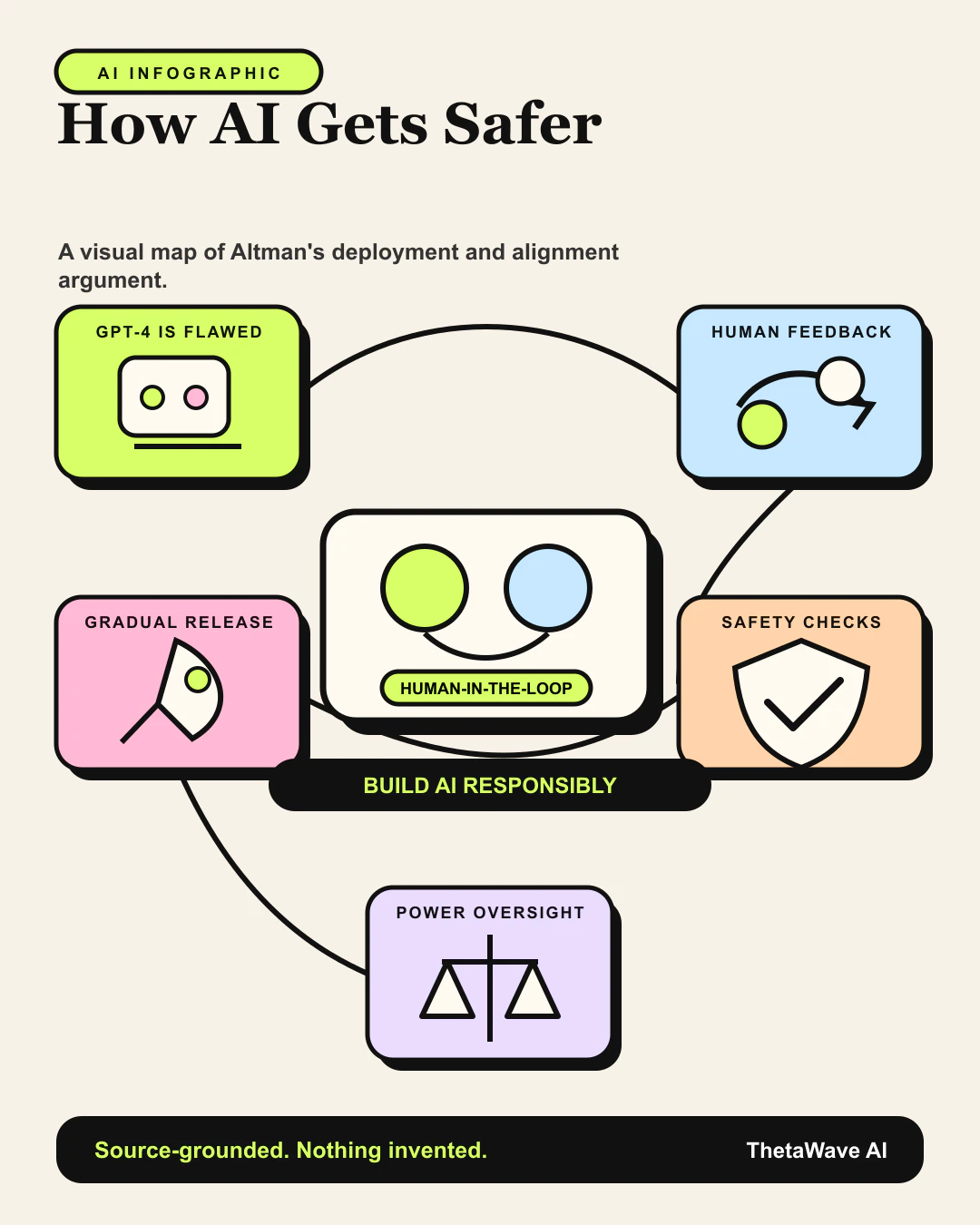
Infographic — a visual summary of the GPT-4 conversation
The full conversation compressed into one shareable poster: capabilities, the RLHF loop, the deployment philosophy, and the main risks.
- Built from the conversation's claims — based on the original talk
- Orders the ideas the way they build across the interview
- Connects capabilities, RLHF, deployment, and governance in one review path
Podcast — listen to the Altman conversation on your commute
A two-host walkthrough of Altman's key claims — so you can review the argument without sitting through 2.5 hours.
- Natural dialogue covering capabilities, RLHF, deployment, and risk
- Two-host script walks through the argument
- Plays in your browser and stays based on the original conversation
Sam Altman: OpenAI CEO on GPT-4, ChatGPT, and the Future of AI | Lex Fridman Podcast #367
Host 1: OpenAI's Sam Altman sat down with Lex Fridman right after GPT-4 shipped. What's the big takeaway?
Host 2: Humility, honestly. Altman keeps saying GPT-4 is impressive but flawed — it still hallucinates, so treat it as a tool, not an oracle.
More notes for AI & Tech
Same study format, different source. Compare how ThetaWave turns related material into notes, maps, quizzes, flashcards, and visuals.
Elon Musk: War, AI, Aliens, Politics, Physics, Video Games, and Humanity | Lex Fridman Podcast #400
Lex Fridman · 14.2M views · 2h17m
Long AI and technology conversation that benefits from a structured theme map and recap.
Sam Altman: OpenAI, GPT-5, Sora, Board Saga, Elon Musk, Ilya, Power & AGI | Lex Fridman Podcast #419
Lex Fridman · 2.5M views · 1h55m
Connects AGI, model progress, safety, and product direction into a long-form AI discussion.
Andrej Karpathy — “We’re summoning ghosts, not building animals”
Dwarkesh Patel · 1.3M views · 2h26m
Technical AI interview with high concept density, strong fit for mind maps and notes.
Jensen Huang: NVIDIA - The $4 Trillion Company & the AI Revolution | Lex Fridman Podcast #494
Lex Fridman · 1.2M views · 2h26m
Long AI infrastructure and Nvidia interview with clear recap demand.
Frequently Asked Questions
Everything you need to know about sam altman: openai ceo on gpt-4, chatgpt, and the future of ai | lex fridman podcast #367.
Turn any YouTube video into notes like this.
Paste a YouTube link and get source-based notes, a mind map, quiz, flashcards, infographic, and podcast preview in minutes.