Structured Notes for TEAS 7 Science Most Common Questions 2026
A current TEAS science question review that can become targeted quiz practice and flashcards. The notes turn that into a concrete path: Group common TEAS questions by science topic and cue words; Review why wrong answers are tempting; Turn each miss into a card or one-line rule.
- Group common TEAS questions by science topic and cue words
- Review why wrong answers are tempting
- Turn each miss into a card or one-line rule
Key takeaways
- A current TEAS science question review that can become targeted quiz practice and flashcards.
- Nurse Cheung's 29m focused video gives A&P and TEAS science students this TEAS 7 science question review focused on recurring cues, answer choices, and fast correction path: Group common TEAS questions by science topic and cue words, then Turn each miss into a card or one-line rule.
- TEAS 7 Science Most Common Questions 2026 is treated as a focused anatomy and physiology review, so the first review action is to Group common TEAS questions by science topic and cue words.
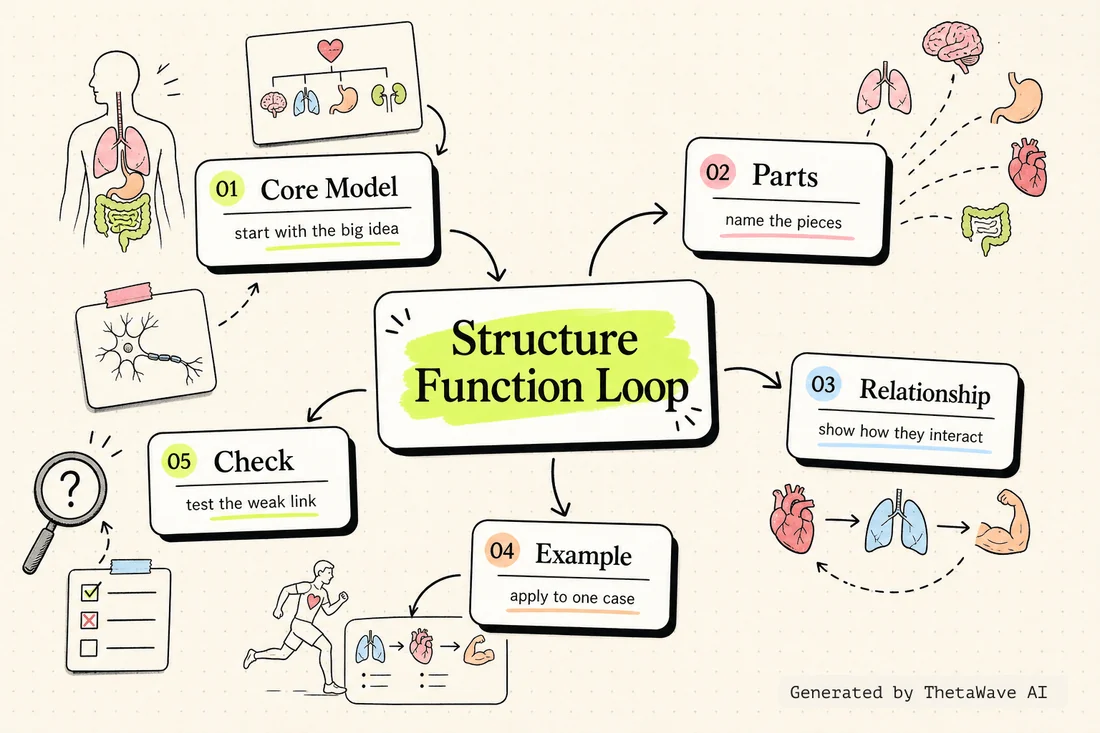
Mind Map - connect TEAS science topics, common question cues, answer traps, and review rules
TEAS science topics, common question cues, answer traps, and review rules is the visual anchor for this page. Around it, structure, function, organ system, and exam cue become the review branches that help A&P and TEAS science students see what belongs together.
- Center of the map: TEAS science topics, common question cues, answer traps, and review rules
- Branch cues: structure, function, organ system, and exam cue
- Review question kept on the page: What pattern does this TEAS science question test?
Quiz - test TEAS science question recognition and correction
TEAS science question recognition and correction is the recall job. A wrong answer is treated as a signal to practice this repair move: Study the cue and the reason, so a new version of the question is still answerable.
- Question focus: TEAS science question recognition and correction
- Mistake to notice: Reviewing common questions as memorized answers
- Correction to practice: Study the cue and the reason, so a new version of the question is still answerable.
“Reviewing common questions as memorized answers” — is this a recommended approach?
Flashcards - repeat common TEAS science cues, terms, and answer-choice traps
This card set is intentionally narrow: it repeats common TEAS science cues, terms, and answer-choice traps and points missed answers back to Turn each miss into a card or one-line rule.
- Front-side cue: common TEAS science cues, terms, and answer-choice traps
- Back-side answer: connect the cue to What pattern does this TEAS science question test?
- Missed cards point back to this move: Turn each miss into a card or one-line rule
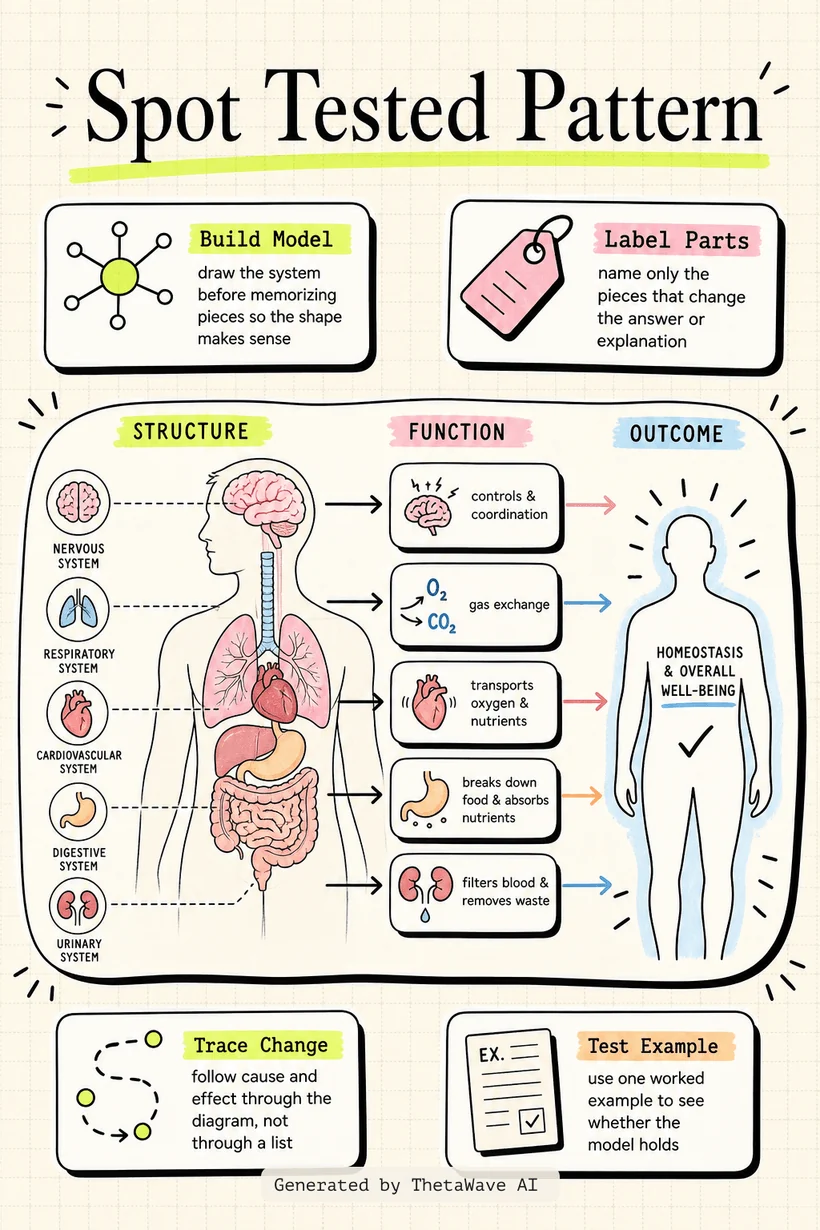
Infographic - a visual summary of a TEAS 7 science question checklist
The visual poster centers on a TEAS 7 science question checklist. It shows the review path as panels - Group common TEAS questions by science topic and cue words, Review why wrong answers are tempting, then Turn each miss into a card or one-line rule - so the topic can be understood quickly before deeper review.
- Panel sequence: Group common TEAS questions by science topic and cue words; Review why wrong answers are tempting; Turn each miss into a card or one-line rule
- Visual story: a TEAS 7 science question checklist
- Learner action: pair each structure with its function and one identifying clue
Podcast - review how to review common TEAS science questions as patterns
The spoken recap for TEAS 7 Science Most Common Questions 2026 follows how to review common TEAS science questions as patterns, then returns to the question that shapes the page: What pattern does this TEAS science question test?
- Opening question: What pattern does this TEAS science question test?
- Plain-language recap of Group common TEAS questions by science topic and cue words
- Closing review cue: Turn each miss into a card or one-line rule
TEAS 7 Science Most Common Questions 2026
Host 1: TEAS 7 Science Most Common Questions 2026 sits in Anatomy & Physiology Notes because it helps A&P and TEAS science students work on body systems, structure-function links, terminology, and exam cues.
Host 2: A current TEAS science question review that can become targeted quiz practice and flashcards.
More notes for Anatomy & Physiology Notes
Same study format, different source. Compare how ThetaWave turns related material into notes, maps, quizzes, flashcards, and visuals.

Comprehensive 2026 ATI TEAS 7 Anatomy & Physiology Study Guide
Nurse Cheung · 602K views · 2h22m
A TEAS A&P study guide with high review value for organ systems, terminology, and practice questions.
Anatomy & Physiology 1: ENTIRE Course Explained in One Video
Organized Biology · 140K views · 1h11m
A full A&P overview that can be organized into systems, terms, and concept checks.
Anatomy and Physiology 101: The ULTIMATE Overview
Organized Biology · 437K views · 56m
A beginner-friendly A&P overview that helps students orient before deeper review.
MASSIVE Final Exam Review - Anatomy & Physiology 1
Organized Biology · 61K views · 1h42m
A final exam review source suited to question practice, terminology flashcards, and system maps.
Frequently Asked Questions
Everything you need to know about teas 7 science most common questions 2026.
Turn any YouTube video into notes like this.
Paste a YouTube link and get source-based notes, a mind map, quiz, flashcards, infographic, and podcast preview in minutes.