Structured Notes for How The Economic Machine Works
How The Economic Machine Works is organized around transactions, credit, debt cycles, and productivity. The notes keep credit drives economic cycles visible, then move through defines transactions before cycles and separates credit, debt, spending, and income.
- Defines transactions before cycles
- Separates credit, debt, spending, and income
- Connects short-term and long-term cycles
Key takeaways
- The economy is explained as a machine built from transactions between buyers and sellers.
- Credit expands spending power, which can increase income in the short run and debt burden later.
- Short-term and long-term debt cycles help explain booms, recessions, and deleveraging.
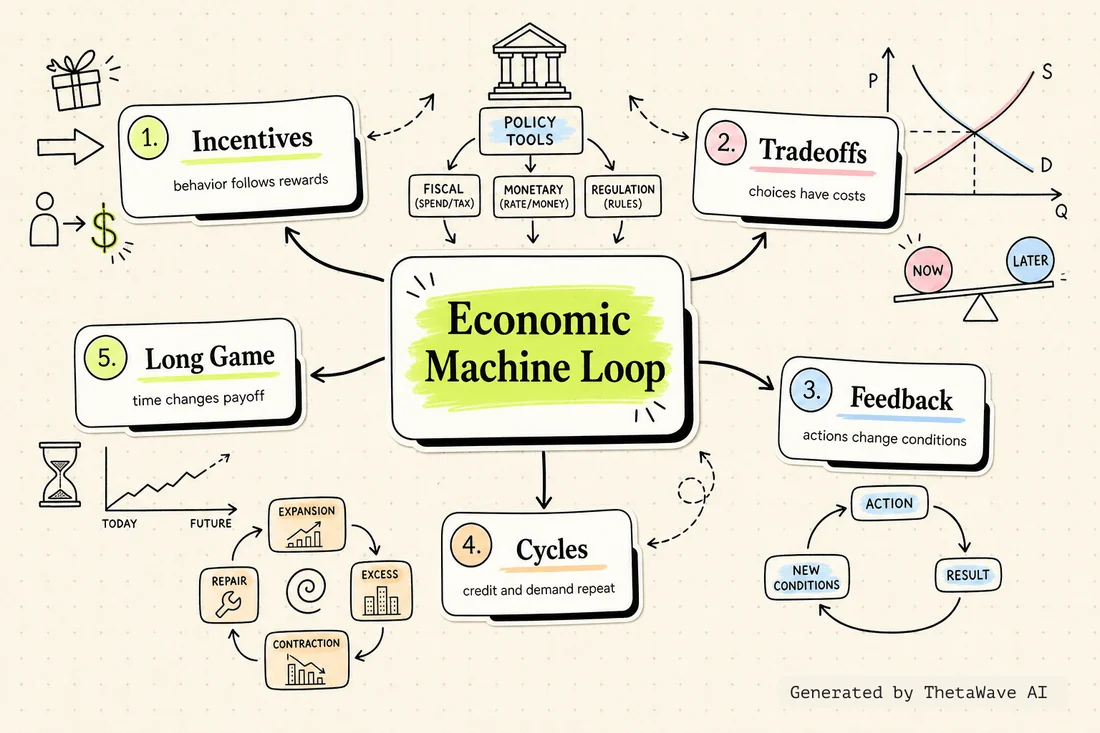
Mind Map - see the economic machine at a glance
the economic machine becomes the center of the map, with branches for shows transactions, credit, debt, productivity, and deleveraging, makes the system model reviewable, and useful for macroeconomics study.
- Shows transactions, credit, debt, productivity, and deleveraging
- Makes the system model reviewable
- Useful for macroeconomics study
Quiz - test your grasp of credit and debt cycles
The quiz asks the learner to use credit and debt cycles in context. The answer feedback points back to thinking debt only matters when it is obviously bad and the repair move: Study how credit can raise spending now while creating repayment pressure later..
- Tests cycle vocabulary
- Checks cause and effect in credit expansion
- Reviews productivity vs debt cycles
“Thinking debt only matters when it is obviously bad” — is this a recommended approach?
Flashcards - repeat macro cycle terms
macro cycle terms become short front/back cards. The cards are tuned to trace a transaction, so a missed answer points back to the idea that needs another pass.
- Cards for transaction, credit, debt, deleveraging, and productivity
- Back side explains each term plainly
- Good for economics review
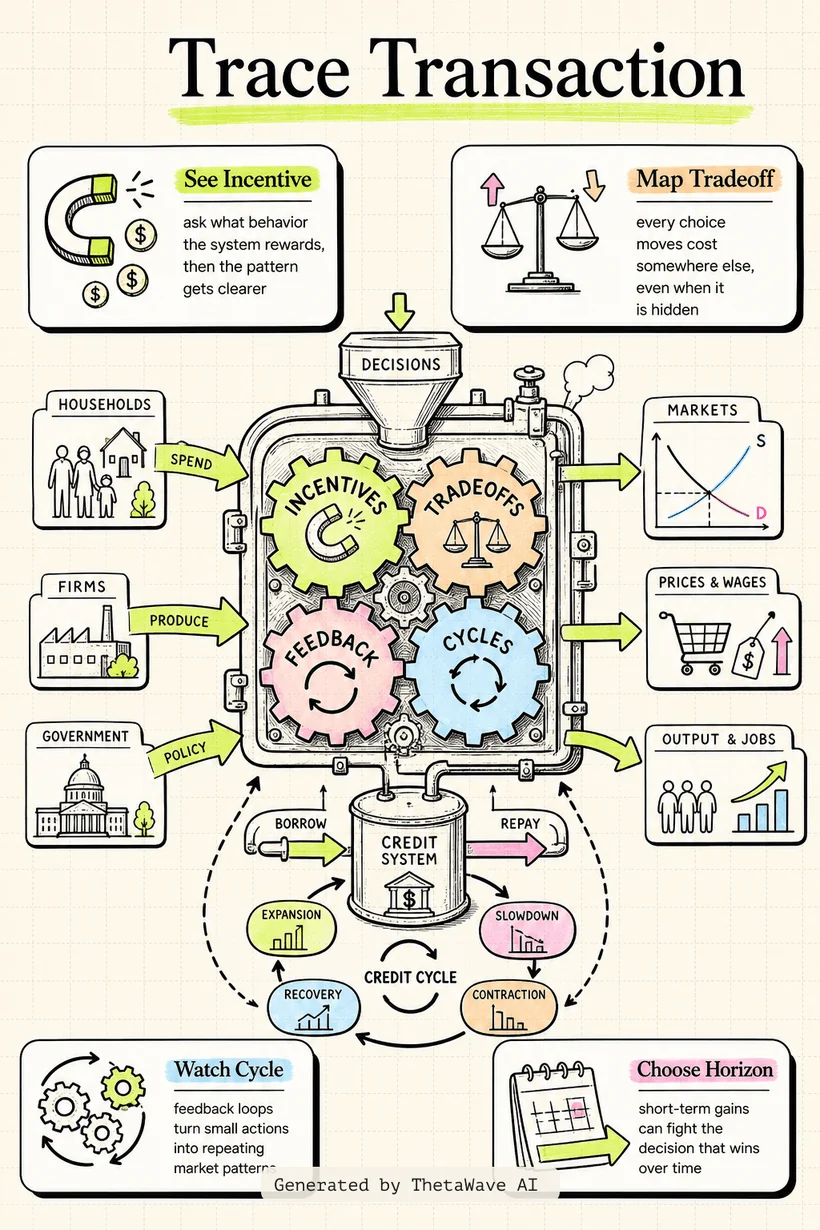
Infographic - a visual summary of the economic machine
The infographic explains the economic machine as a visual sequence. It is meant to make credit drives economic cycles easier to grasp before the learner moves into notes, quiz, or cards.
- Visualizes the economic machine as a sequence
- Shows how credit affects spending and debt
- Keeps the model easy to remember
Podcast - listen to the economic machine recap
economic machine becomes a short review conversation. It follows the same learning target as the page: trace a transaction.
- Audio recap explains Dalio's model step by step
- Connects transactions to cycles
- Good for quick macro review
How The Economic Machine Works by Ray Dalio
Host 1: Dalio starts with the smallest unit: a transaction.
Host 2: Once you have transactions, credit changes the machine because it lets spending rise before income has actually been earned.
More notes for Economics & Finance
Same study format, different source. Compare how ThetaWave turns related material into notes, maps, quizzes, flashcards, and visuals.
Macroeconomics- Everything You Need to Know
Jacob Clifford · 4.2M views · 30m
A compact macroeconomics review suited to structured notes, key terms, and quiz questions.
Microeconomics- Everything You Need to Know
Jacob Clifford · 3.9M views · 29m
A compact microeconomics review that can be broken into concepts, graphs, and practice checks.
ALL OF ECONOMICS in 20 minutes
20 Minute University · 2.9M views · 21m
Broad economics overview that works well as a quick concept map and summary page.

Fundamentals of Finance & Economics for Businesses - Crash Course
freeCodeCamp.org · 2.3M views · 1h38m
Longer finance and economics source with enough structure for notes, terms, and practice checks.
Frequently Asked Questions
Everything you need to know about how the economic machine works by ray dalio.
Turn any YouTube video into notes like this.
Paste a YouTube link and get source-based notes, a mind map, quiz, flashcards, infographic, and podcast preview in minutes.