Structured Notes for Solving Wordle using information theory
Solving Wordle using information theory is handled as a focused review source for information theory explained through guesses, entropy, uncertainty, and Wordle strategy. The notes begin with Treat each guess as an information-gathering move and end with use examples to separate a lucky guess from a useful guess.
- Treat each guess as an information-gathering move
- Connect entropy to the number of possible answers left
- Use examples to separate a lucky guess from a useful guess
Key takeaways
- Turns information theory into an intuitive game example, useful for notes, quizzes, and visual explanation.
- 3Blue1Brown's 31m focused video gives students learning from visual math and science explanations this information theory explained through guesses, entropy, uncertainty, and Wordle strategy path: Treat each guess as an information-gathering move, then use examples to separate a lucky guess from a useful guess.
- Solving Wordle using information theory is treated as a focused visual science explanation, so the first review action is to Treat each guess as an information-gathering move.
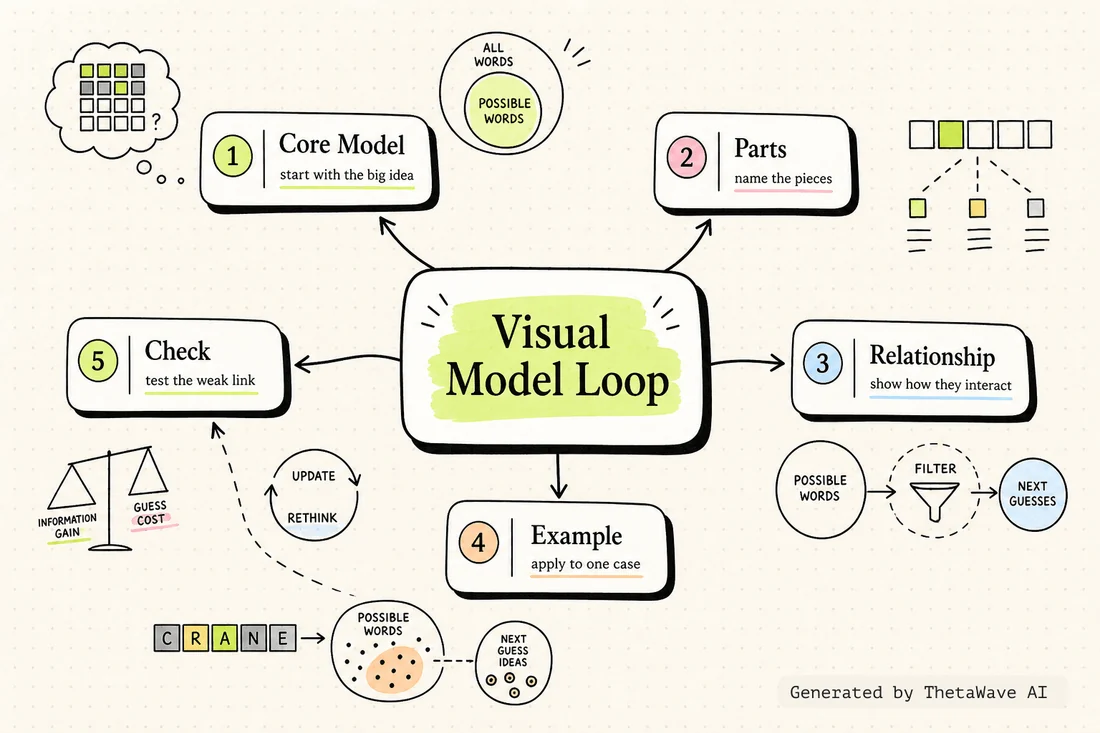
Mind Map - connect Wordle guesses, entropy, uncertainty, feedback, and decision strategy
The map for Solving Wordle using information theory turns Which guess reduces uncertainty the most? into a visible layout, with model, visual cue, concept, and application acting as the checkpoints around Wordle guesses, entropy, uncertainty, feedback, and decision strategy.
- Center of the map: Wordle guesses, entropy, uncertainty, feedback, and decision strategy
- Branch cues: model, visual cue, concept, and application
- Review question kept on the page: Which guess reduces uncertainty the most?
Quiz - test how information gain changes the next guess
For students learning from visual math and science explanations, the quiz is useful only if it exposes a weak decision. Here, that weak spot is choosing the word that feels most likely instead of the word that gives the best information.
- Question focus: how information gain changes the next guess
- Mistake to notice: Choosing the word that feels most likely instead of the word that gives the best information
- Correction to practice: Measure the value of a guess by how much uncertainty it removes.
“Choosing the word that feels most likely instead of the word that gives the best information” — is this a recommended approach?
Flashcards - repeat entropy, uncertainty, feedback, probability, and strategy terms
Cards for this page keep entropy, uncertainty, feedback, probability, and strategy terms separate from the longer notes. Each cue helps students learning from visual math and science explanations return to models, visual cues, core concepts, and transfer examples without rewatching the whole video first.
- Front-side cue: entropy, uncertainty, feedback, probability, and strategy terms
- Back-side answer: connect the cue to Which guess reduces uncertainty the most?
- Missed cards point back to this move: use examples to separate a lucky guess from a useful guess
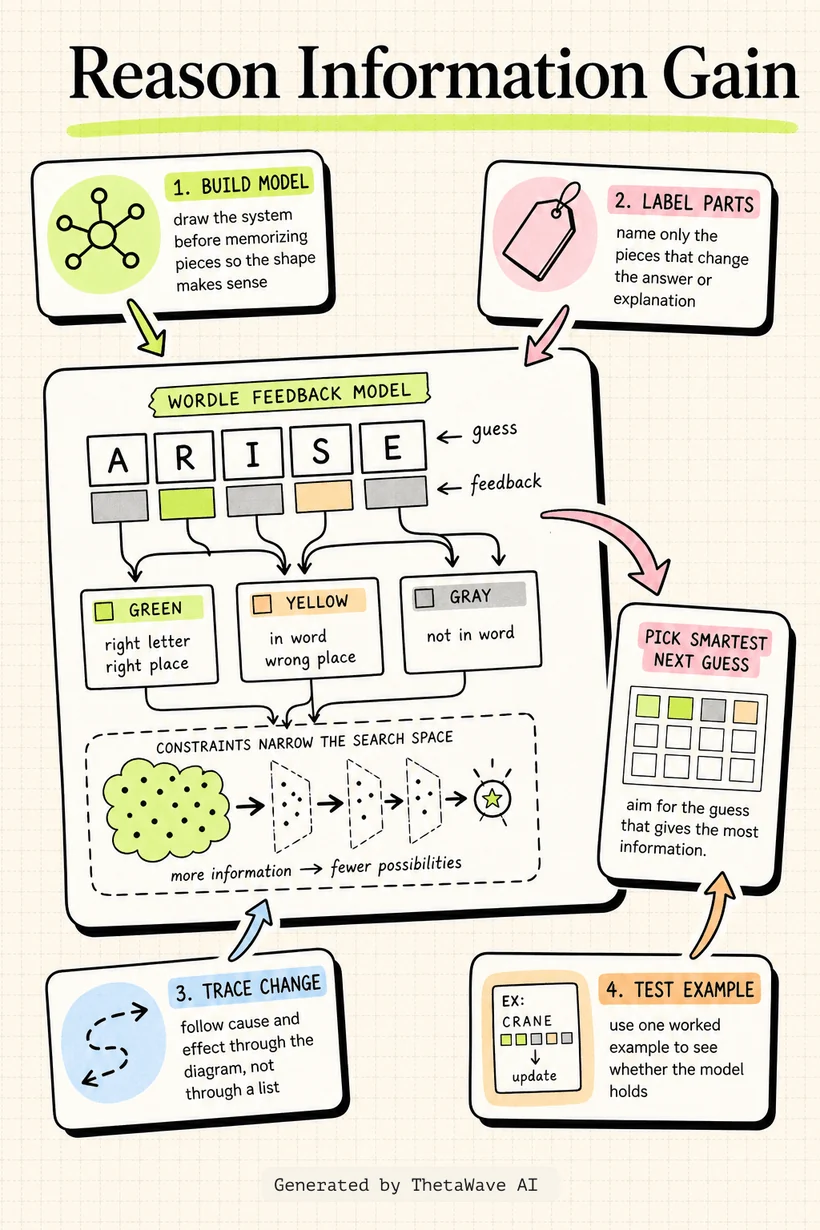
Infographic - a visual summary of a Wordle decision tree based on information gain
The visual guide for Solving Wordle using information theory explains a Wordle decision tree based on information gain with a panel sequence: Treat each guess as an information-gathering move, connect entropy to the number of possible answers left, and use examples to separate a lucky guess from a useful guess.
- Panel sequence: Treat each guess as an information-gathering move; Connect entropy to the number of possible answers left; Use examples to separate a lucky guess from a useful guess
- Visual story: a Wordle decision tree based on information gain
- Learner action: explain what the model shows and apply the same idea to a new example
Podcast - review why a game example makes information theory easier to study
why a game example makes information theory easier to study becomes the listening path. The hosts move from Treat each guess as an information-gathering move toward use examples to separate a lucky guess from a useful guess, matching the rest of the study page.
- Opening question: Which guess reduces uncertainty the most?
- Plain-language recap of Treat each guess as an information-gathering move
- Closing review cue: use examples to separate a lucky guess from a useful guess
Solving Wordle using information theory
Host 1: Solving Wordle using information theory sits in Math & Science Visualizations because it helps students learning from visual math and science explanations work on models, visual cues, core concepts, and transfer examples.
Host 2: Turns information theory into an intuitive game example, useful for notes, quizzes, and visual explanation.
More notes for Math & Science Visualizations
Same study format, different source. Compare how ThetaWave turns related material into notes, maps, quizzes, flashcards, and visuals.
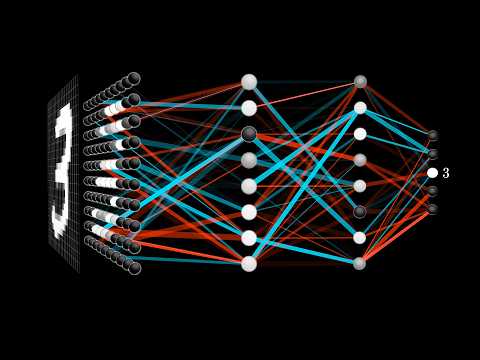
But what is a neural network? | Deep learning chapter 1
3Blue1Brown · 23.3M views · 19m
A visual AI foundations explainer that can become a concept map of layers, weights, activations, and learning.

The Most Important Material Ever Made
Veritasium · 9.3M views · 22m
A high-reach science explainer that benefits from a cause-effect visual summary.

Calculus 1 - Full College Course
freeCodeCamp.org · 9.1M views · 11h54m
A long calculus course that can be organized into chapter notes, definitions, examples, and practice checks.

How are holograms possible?
3Blue1Brown · 6.7M views · 46m
A visual physics and math explainer that fits diagrams, concept checks, and a concise study recap.
Frequently Asked Questions
Everything you need to know about solving wordle using information theory.
Turn any YouTube video into notes like this.
Paste a YouTube link and get source-based notes, a mind map, quiz, flashcards, infographic, and podcast preview in minutes.