Structured Notes for The Limit of a Function
A scan-friendly outline of Calculus Vol. 1 2.2 organized around Limit Notation, One-Sided Limits, Numerical Tables.
- The Limit of a Function Learning Objectives 2.2.1 Using correct notation, describe the limit of a function.
- Track the section's working concepts: Limit Notation, One-Sided Limits, Numerical Tables, Graphical Limits.
- Use the outline to move from textbook wording into recall-ready relationships.
Key takeaways
- The Limit of a Function Learning Objectives 2.2.1 Using correct notation, describe the limit of a function.
- 2.2.2 Use a table of values to estimate the limit of a function or to identify when the limit does not exist.
- 2.2.3 Use a graph to estimate the limit of a function or to identify when the limit does not exist.
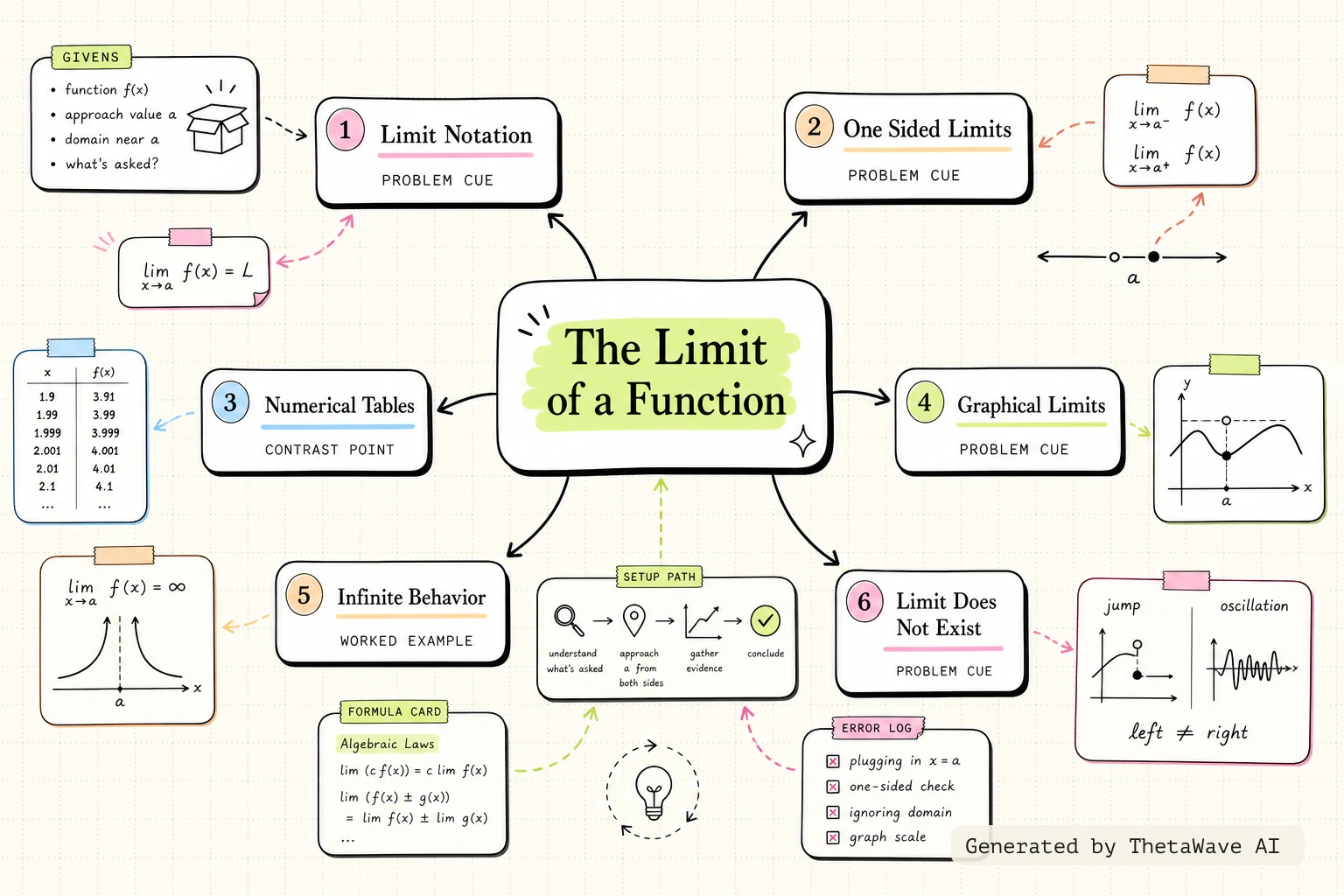
Mind Map — connect the parts of The Limit of a Function
The map keeps The Limit of a Function in the center, then branches into Limit Notation, One-Sided Limits, Numerical Tables, Graphical Limits, Infinite Behavior for quick recall.
- Center node: The Limit of a Function
- Branch review: Limit Notation · One-Sided Limits · Numerical Tables · Graphical Limits · Infinite Behavior · Limit Does Not Exist
- Best for a quick structure check before practice questions.
Quiz — check whether The Limit of a Function actually sticks
Practice questions check definitions, contrasts, and applications across Limit Notation, One-Sided Limits, Numerical Tables.
- True/false and short-answer checks on Limit Notation, One-Sided Limits, Numerical Tables
- 2.2.2 Use a table of values to estimate the limit of a function or to identify when the limit does not exist.
- Answer explanations point back to the Calculus Vol. 1 2.2 section structure.
“Treating the limit of a function as a vocabulary list” — is this a recommended approach?
Flashcards — remember The Limit of a Function terms faster
Cards separate the section's definitions, contrasts, and application cues for Limit Notation, One-Sided Limits, Numerical Tables.
- Limit Notation cards for definitions and examples
- One-Sided Limits and Numerical Tables comparison cards
- One application card built around the mistake this section tends to create.
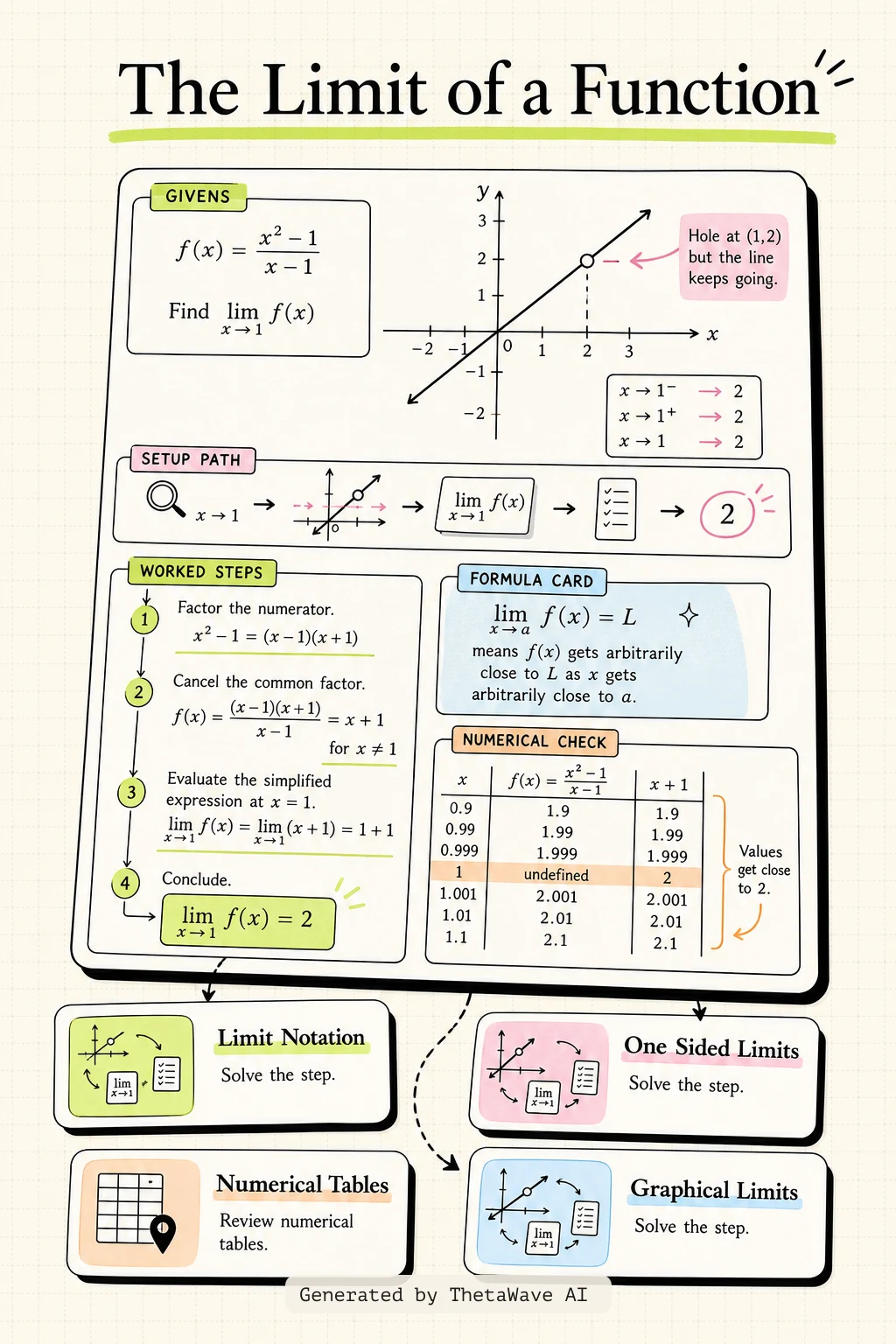
Infographic — see The Limit of a Function as a one-page review
A visual poster turns the limit of a function into a compact path: Limit Notation → One-Sided Limits → Numerical Tables.
- Top band: The Limit of a Function from Calculus Volume 1
- Middle cards: Limit Notation, One-Sided Limits, Numerical Tables, Graphical Limits, Infinite Behavior
- Bottom cue: what to test yourself on after reading.
Podcast — review The Limit of a Function by listening
A short two-host preview turns the section into a listenable review of Limit Notation, One-Sided Limits, Numerical Tables.
- Starts with why The Limit of a Function matters
- Compares Limit Notation with One-Sided Limits
- Closes with a recall question for the next study pass.
The Limit of a Function Notes
Host 1: This OpenStax section is about The Limit of a Function. What should a student be able to explain after reading it?
Host 2: The Limit of a Function Learning Objectives 2.2.1 Using correct notation, describe the limit of a function.
More notes for OpenStax Calculus
Same study format, different source. Compare how ThetaWave turns related material into notes, maps, quizzes, flashcards, and visuals.
1.1 Review of Functions
OpenStax · Rice University · 8 min read
Review Calculus Vol. 1 1.1: Review of Functions as structured notes, practice questions, flashcards, and visual summaries tied to the original OpenStax reading.
1.2 Basic Classes of Functions
OpenStax · Rice University · 7 min read
Review Calculus Vol. 1 1.2: Basic Classes of Functions as structured notes, practice questions, flashcards, and visual summaries tied to the original OpenStax reading.
1.3 Trigonometric Functions
OpenStax · Rice University · 7 min read
Review Calculus Vol. 1 1.3: Trigonometric Functions as structured notes, practice questions, flashcards, and visual summaries tied to the original OpenStax reading.
1.4 Inverse Functions
OpenStax · Rice University · 8 min read
Review Calculus Vol. 1 1.4: Inverse Functions as structured notes, practice questions, flashcards, and visual summaries tied to the original OpenStax reading.
Frequently Asked Questions
Everything you need to know about the limit of a function notes.
Turn any textbook into notes like this.
Upload or paste source material and get notes, a mind map, quiz, flashcards, infographic, and podcast preview in minutes.