Structured Notes for How to Study for Pharmacology in Nursing School
For How to Study for Pharmacology in Nursing School, the notes ask the learner to Study medications by class before memorizing individual names, connect mechanism, indication, side effect, contraindication, and nursing assessment, and use flashcards and practice questions to check safe-patient reasoning. The page stays anchored to the source's study job.
- Study medications by class before memorizing individual names
- Connect mechanism, indication, side effect, contraindication, and nursing assessment
- Use flashcards and practice questions to check safe-patient reasoning
Key takeaways
- A nursing pharmacology study-method video that can become a practical review workflow.
- RegisteredNurseRN's 13m focused video gives nursing pharmacology students this nursing pharmacology study method built around drug classes, actions, side effects, and patient safety path: Study medications by class before memorizing individual names, then use flashcards and practice questions to check safe-patient reasoning.
- How to Study for Pharmacology in Nursing School is treated as a focused nursing pharmacology review, so the first review action is to Study medications by class before memorizing individual names.
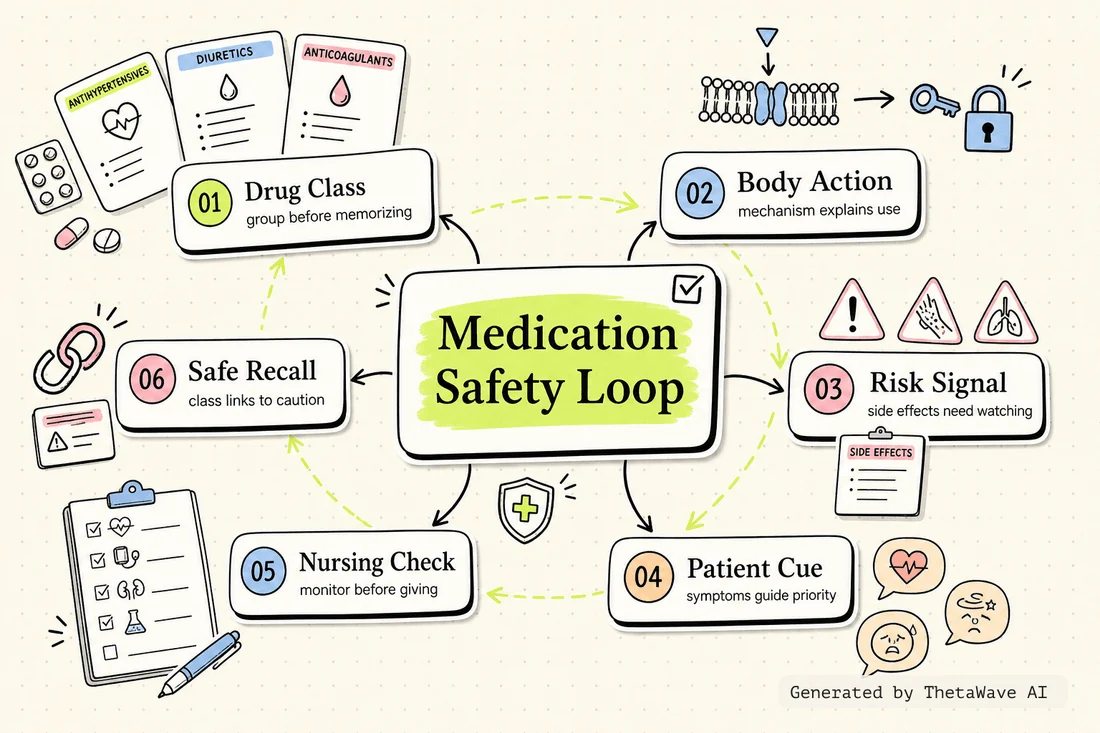
Mind Map - connect drug class, mechanism, indication, side effects, nursing assessment, and safety
Visual review stays narrow here: drug class, mechanism, indication, side effects, nursing assessment, and safety in the center, drug class, action, risk, and nursing cue around it, and the learner question kept close to the map.
- Center of the map: drug class, mechanism, indication, side effects, nursing assessment, and safety
- Branch cues: drug class, action, risk, and nursing cue
- Review question kept on the page: How should a nursing student organize a drug so it is usable in clinical judgment?
Quiz - test pharmacology study choices for nursing school
How to Study for Pharmacology in Nursing School's quiz targets pharmacology study choices for nursing school. The feedback uses the likely failure mode - trying to memorize long medication lists without grouping by class and safety cue - and turns it into this correction: Start with class and patient-safety cue, then add individual drug details.
- Question focus: pharmacology study choices for nursing school
- Mistake to notice: Trying to memorize long medication lists without grouping by class and safety cue
- Correction to practice: Start with class and patient-safety cue, then add individual drug details.
“Trying to memorize long medication lists without grouping by class and safety cue” — is this a recommended approach?
Flashcards - repeat drug classes, mechanisms, side effects, contraindications, and nursing cues
Flashcards for How to Study for Pharmacology in Nursing School focus on drug classes, mechanisms, side effects, contraindications, and nursing cues, giving the learner a shorter way to revisit drug classes, medication actions, patient risks, and monitoring cues after the first pass.
- Front-side cue: drug classes, mechanisms, side effects, contraindications, and nursing cues
- Back-side answer: connect the cue to How should a nursing student organize a drug so it is usable in clinical judgment?
- Missed cards point back to this move: use flashcards and practice questions to check safe-patient reasoning
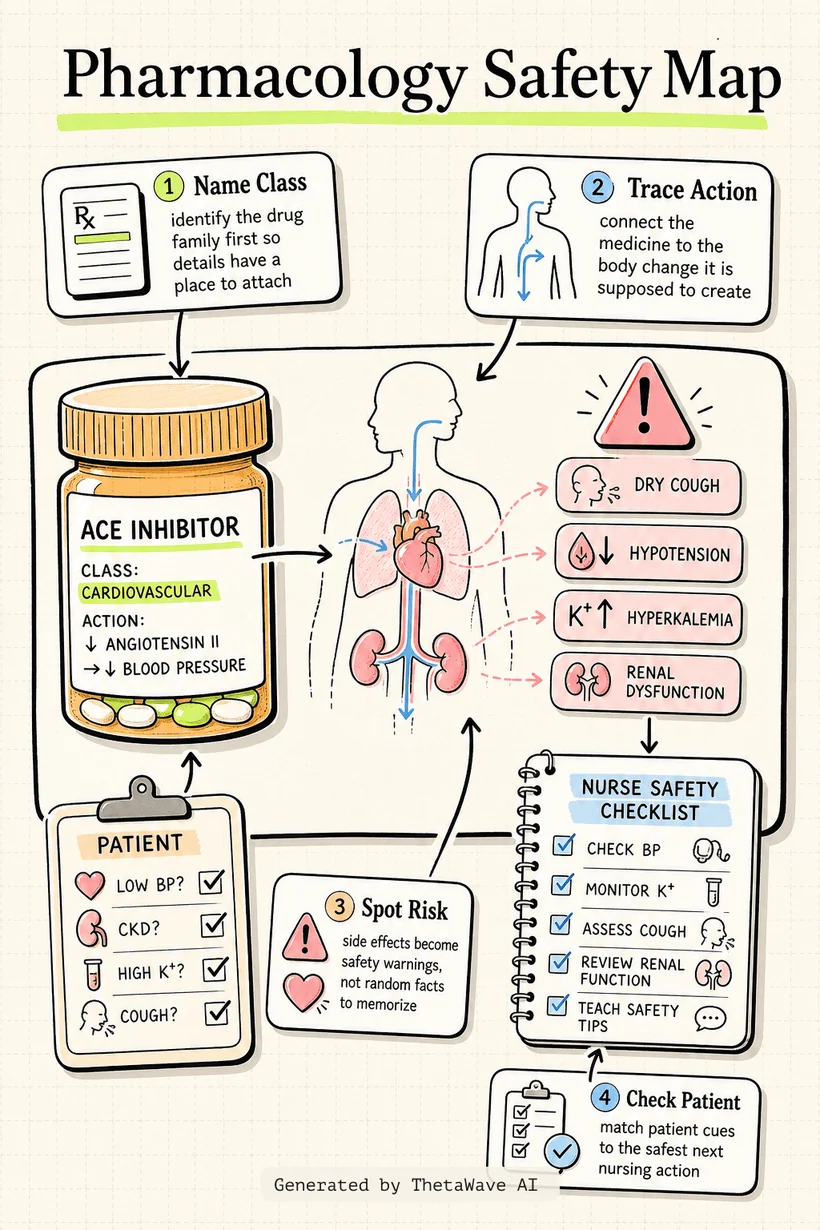
Infographic - a visual summary of a nursing pharmacology study workflow
a nursing pharmacology study workflow becomes the poster story. The first panel starts with Study medications by class before memorizing individual names; the last panel ends with use flashcards and practice questions to check safe-patient reasoning.
- Panel sequence: Study medications by class before memorizing individual names; Connect mechanism, indication, side effect, contraindication, and nursing assessment; Use flashcards and practice questions to check safe-patient reasoning
- Visual story: a nursing pharmacology study workflow
- Learner action: read medication patterns by class, action, risk, and patient cue
Podcast - review how to study pharmacology so it supports patient-safety decisions
For audio-style review, the page keeps one job in focus: explain how to study pharmacology so it supports patient-safety decisions clearly enough that nursing pharmacology students can restart the source with context.
- Opening question: How should a nursing student organize a drug so it is usable in clinical judgment?
- Plain-language recap of Study medications by class before memorizing individual names
- Closing review cue: use flashcards and practice questions to check safe-patient reasoning
How to Study for Pharmacology in Nursing School
Host 1: How to Study for Pharmacology in Nursing School sits in Pharmacology / Nursing Pharmacology Notes because it helps nursing pharmacology students work on drug classes, medication actions, patient risks, and monitoring cues.
Host 2: A nursing pharmacology study-method video that can become a practical review workflow.
More notes for Pharmacology / Nursing Pharmacology Notes
Same study format, different source. Compare how ThetaWave turns related material into notes, maps, quizzes, flashcards, and visuals.

Pharmacology Made Easy - Common Medication Endings
PicmonicVideo · 1.5M views · 22m
Medication endings are ideal for memory cards, pattern recognition, and quick quiz checks.
2-Hour NCLEX Pharmacology Ultimate Course
Your Nursing Space · 214K views · 1h54m
A long NCLEX pharmacology source suited to medication categories, practice questions, and flashcards.

Pharmacology Cardiovascular Drugs Nursing NCLEX Review
RegisteredNurseRN · 430K views · 31m
Cardiovascular drugs are high-yield for nursing exams and fit mechanism maps and drug cards.
Top NCLEX & Nursing Medications to Know for EXAMS
RegisteredNurseRN · 57K views · 6m
A compact medication list that can be turned into focused flashcards and last-mile review.
Frequently Asked Questions
Everything you need to know about how to study for pharmacology in nursing school.
Turn any YouTube video into notes like this.
Paste a YouTube link and get source-based notes, a mind map, quiz, flashcards, infographic, and podcast preview in minutes.