Structured Notes for How to Learn Faster with the Feynman Technique
The video becomes a compact study method: explain to learn, test your own assumptions, and use simple language to expose gaps.
- The core rule: if you want to understand it, explain it
- Thomas Frank's four-step process with the Pythagorean theorem example
- Why plain language and examples reveal shaky understanding
Key takeaways
- The video reverses a familiar idea: if you want to understand something well, explain it simply.
- The Feynman Technique works across subjects, not only physics — Thomas Frank names history, math, and web development as examples.
- Step one is concrete: write the concept at the top of a page; the video uses the Pythagorean theorem as the worked example.
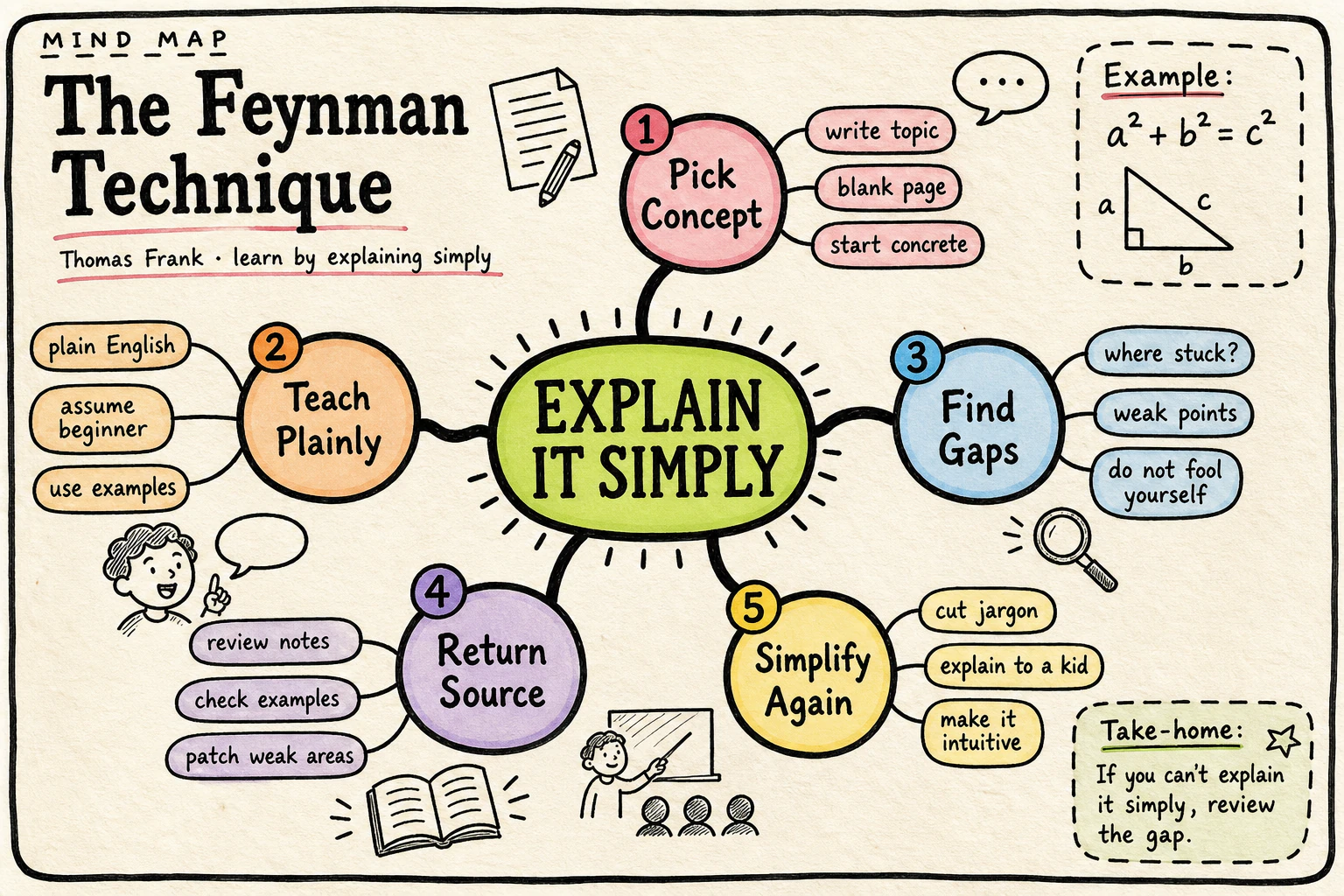
Mind Map — see the Feynman loop at a glance
A five-branch map centered on explaining simply: pick a concept, teach plainly, find gaps, return to the source, and simplify again.
- Center node uses the video's real thesis: explain it simply
- Child nodes preserve the video's concrete steps
- Pythagorean theorem example anchors the abstract method
Quiz — test whether you can use the Feynman Technique
The recall check targets the traps Thomas Frank warns about: stopping at definitions, hiding behind jargon, and skipping the plain example that proves you understand the idea.
- True/False on whether definitions are enough
- Fixes explain the four-step method
- Questions stay tied to Thomas Frank's example-driven explanation
“Defining the concept once and assuming you understand it” — is this a recommended approach?
Flashcards — active recall for each Feynman step
One card per action: name the topic, teach it plainly, find stuck points, review source material, and simplify jargon.
- Built from the video's exact process
- Useful before reviewing a hard concept
- Designed to prevent passive rereading
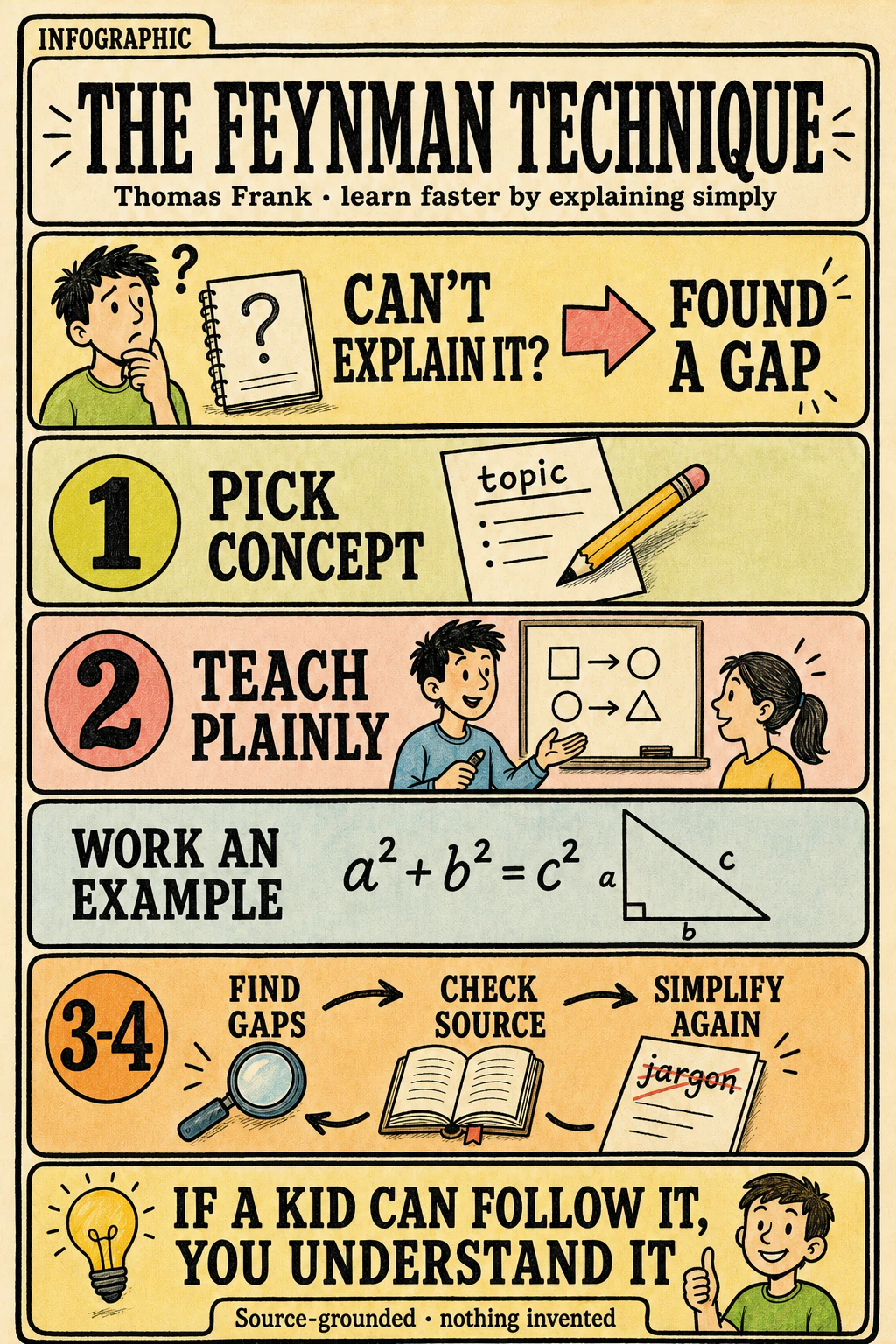
Infographic — a visual loop for learning by teaching
A vivid study scene shows the technique as a loop around a whiteboard: pick concept, teach simply, find gaps, check the source, simplify again.
- Visual modules match the video steps
- Uses the Pythagorean theorem as the worked example
- Short labels keep the image readable
Podcast — listen to the Feynman Technique recap
A two-host recap walks through why explaining reveals understanding gaps and how to apply the four-step loop.
- Covers the quote, the Feynman background, and the process
- Keeps the Pythagorean theorem example
- Plays in your browser and stays based on the original video
How to Learn Faster with the Feynman Technique (Example Included)
Host 1: Thomas Frank starts with the classic idea: if you can't explain something simply, you probably don't understand it well enough.
Host 2: Right, and the Feynman Technique turns that into a process: write the concept down, then teach it in plain language.
More notes for Study Skills
Same study format, different source. Compare how ThetaWave turns related material into notes, maps, quizzes, flashcards, and visuals.

How to study for exams - Evidence-based revision tips
Ali Abdaal · 5.5M views · 21m
Covers practical exam revision habits that can become checklists, quiz questions, and flashcards.
The Most Powerful Way to Remember What You Study
Thomas Frank · 3.9M views · 8m
Memory-focused study advice pairs naturally with active recall and flashcards.

How To Learn Any Skill So Fast It Feels Illegal
Justin Sung · 3.1M views · 14m
Skill-learning topic is broad, student-relevant, and good for a visual study guide.

How to Study for Exams - An Evidence-Based Masterclass
Ali Abdaal · 3.1M views · 2h50m
Walks through a long-form exam preparation system that benefits from structured notes and review cards.
Frequently Asked Questions
Everything you need to know about how to learn faster with the feynman technique (example included).
Turn any YouTube video into notes like this.
Paste a YouTube link and get source-based notes, a mind map, quiz, flashcards, infographic, and podcast preview in minutes.