Structured Notes for Optimal Protocols for Studying & Learning
Huberman's episode rewritten as a scannable outline — the forgetting goal, the testing protocol, focus conditions, and the consolidation stack, without the transcript clutter.
- Why studying is really about offsetting forgetting
- Self-testing as the core tool — not just an exam
- Sleep, NSDR, and the surprising power of brief gaps
Key takeaways
- The real goal of studying is to offset forgetting, not just to take information in — Huberman frames everything around the brain's forgetting curve.
- Self-testing is the single most powerful tool: testing soon after exposure both strengthens memory and exposes the gaps that create the illusion of knowing.
- Focus is a skill that depends on first tolerating distraction; deliberate blocks of roughly 3–4 hours, done alone, beat long passive sessions.
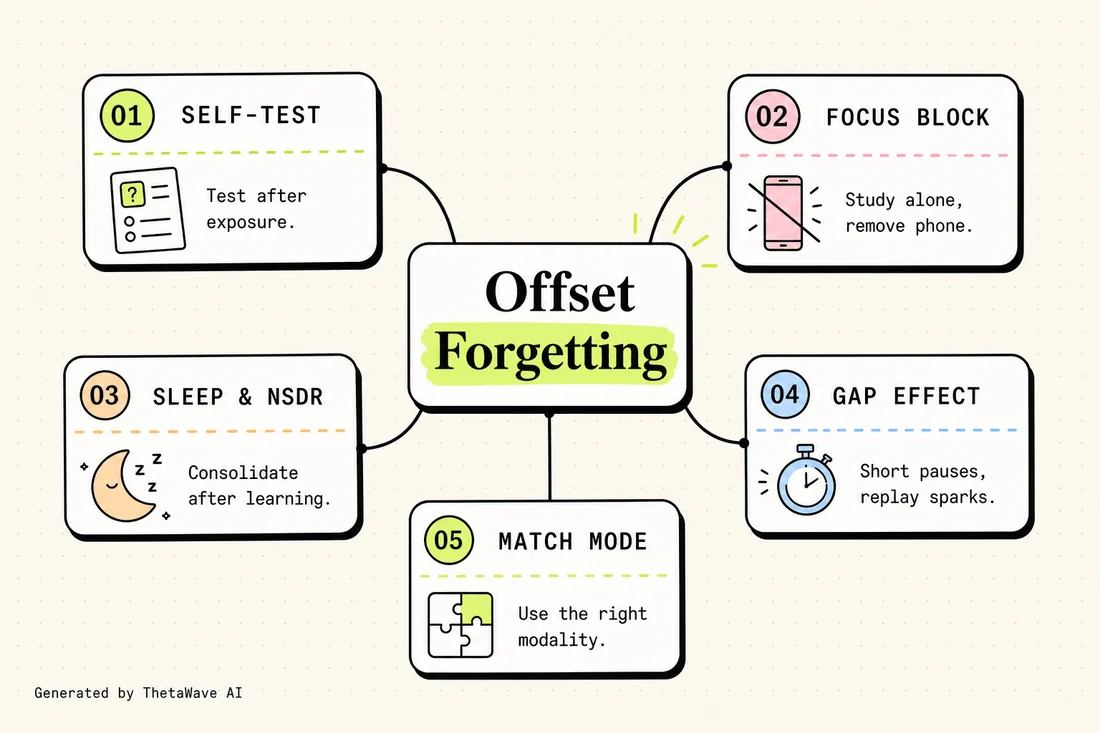
Mind Map — see the whole protocol at a glance
Six branches from one central idea (learning = offsetting forgetting): self-testing, focus, sleep & NSDR, the gap effect, encoding, and learning-style myths.
- Nodes follow the episode's flow, grounded in the original talk
- Color-coded by mechanism: behavior, brain state, and timing
- Useful as a one-page review for a study group or revision session
Quiz — test your grasp of the learning protocols
Active recall on the episode's most counter-intuitive points — the exact mechanism Huberman says drives durable learning.
- True/False on myths like 're-reading is studying'
- Fixes that explain why each protocol works
- Short answer checks so the protocol sticks before your exam
“Re-reading your notes and counting it as studying” — is this a recommended approach?
Flashcards — spaced repetition for the core protocols
One card per actionable rule: test yourself, study alone in focused blocks, sleep after learning, insert short gaps. Built for behavior change, not trivia.
- Each card pairs a protocol with the concrete 'how'
- Flip to reveal the mechanism plus a practical example
- Repeatable self-testing so the rules stick
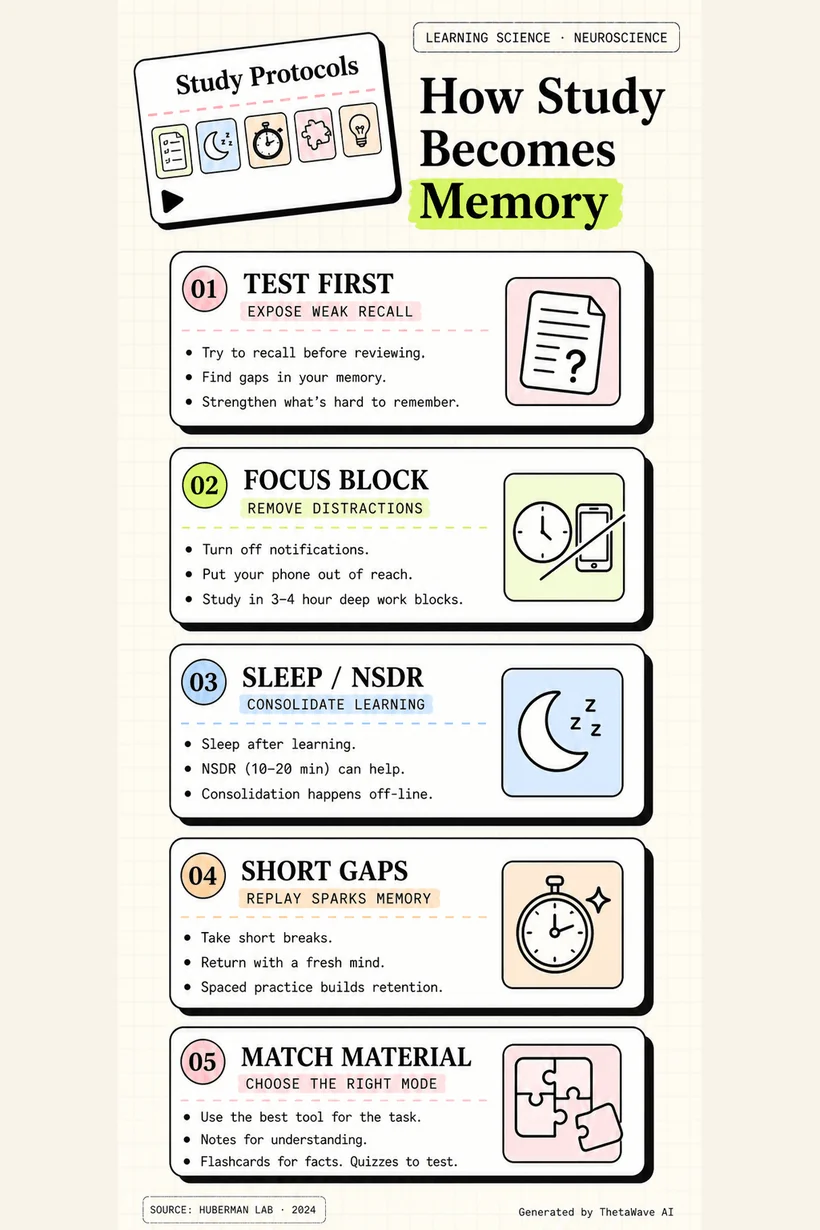
Infographic — a visual summary of the study protocol
The full episode compressed into one shareable poster: the forgetting goal, the testing loop, focus conditions, and the sleep/NSDR/gap consolidation stack.
- Built from the episode's claims — based on the original talk
- Orders the protocols the way you'd actually use them
- Shows how testing, focus, sleep, NSDR, and gaps fit together
Podcast — listen to the study protocols on your commute
A two-host conversation walking through Huberman's protocols — so you can review the science without sitting through the full episode.
- Natural dialogue covering testing, focus, sleep, and gaps
- Two-host script walks through the protocol
- Plays in your browser and stays based on the original episode
Optimal Protocols for Studying & Learning
Host 1: Huberman's whole framing is that studying isn't about putting information in — it's about offsetting forgetting.
Host 2: Right. And the single best tool for that is testing yourself — not as an exam, as the actual study method.
More notes for Learning Science
Same study format, different source. Compare how ThetaWave turns related material into notes, maps, quizzes, flashcards, and visuals.
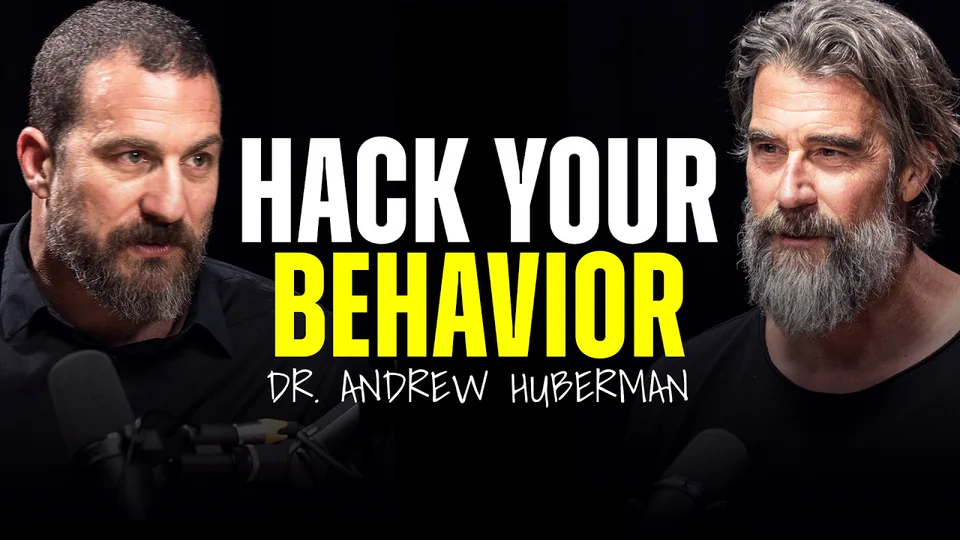
Change Your Brain: Neuroscientist Dr. Andrew Huberman | Rich Roll Podcast
Rich Roll · 18.4M views · 2h13m
Start with the big picture: how brain state, focus, dopamine, stress control, and deep rest shape behavior change.
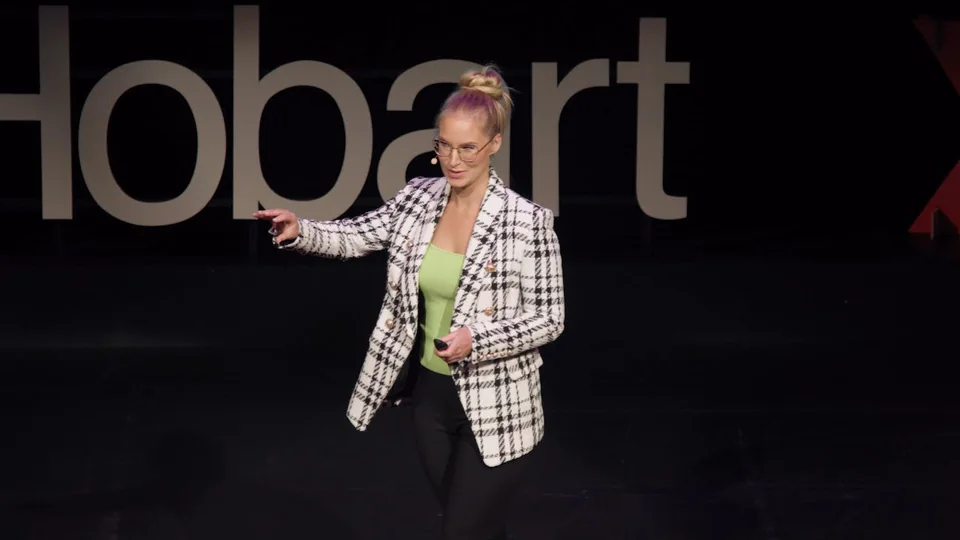
Brain Hack: 6 secrets to learning faster, backed by neuroscience | Lila Landowski | TEDxHobart
TEDx · 7.6M views · 18m
Turn learning science into six study conditions you can use before, during, and after a study session.
Understand & Improve Memory Using Science-Based Tools
Andrew Huberman · 1.2M views · 2h09m
Understand how memories are encoded, strengthened, and consolidated so review tools make more sense.
Science & Tools of Learning & Memory | Dr. David Eagleman
Andrew Huberman · 380K views · 2h24m
Zoom out to lifelong plasticity: novelty, challenge, practice, future-self commitments, and memory drift.
Frequently Asked Questions
Everything you need to know about optimal protocols for studying & learning.
Turn any YouTube video into notes like this.
Paste a YouTube link and get source-based notes, a mind map, quiz, flashcards, infographic, and podcast preview in minutes.